

.jpg)


Speeches and Transcripts
A Pioneer in Macau’s Entertainment Business
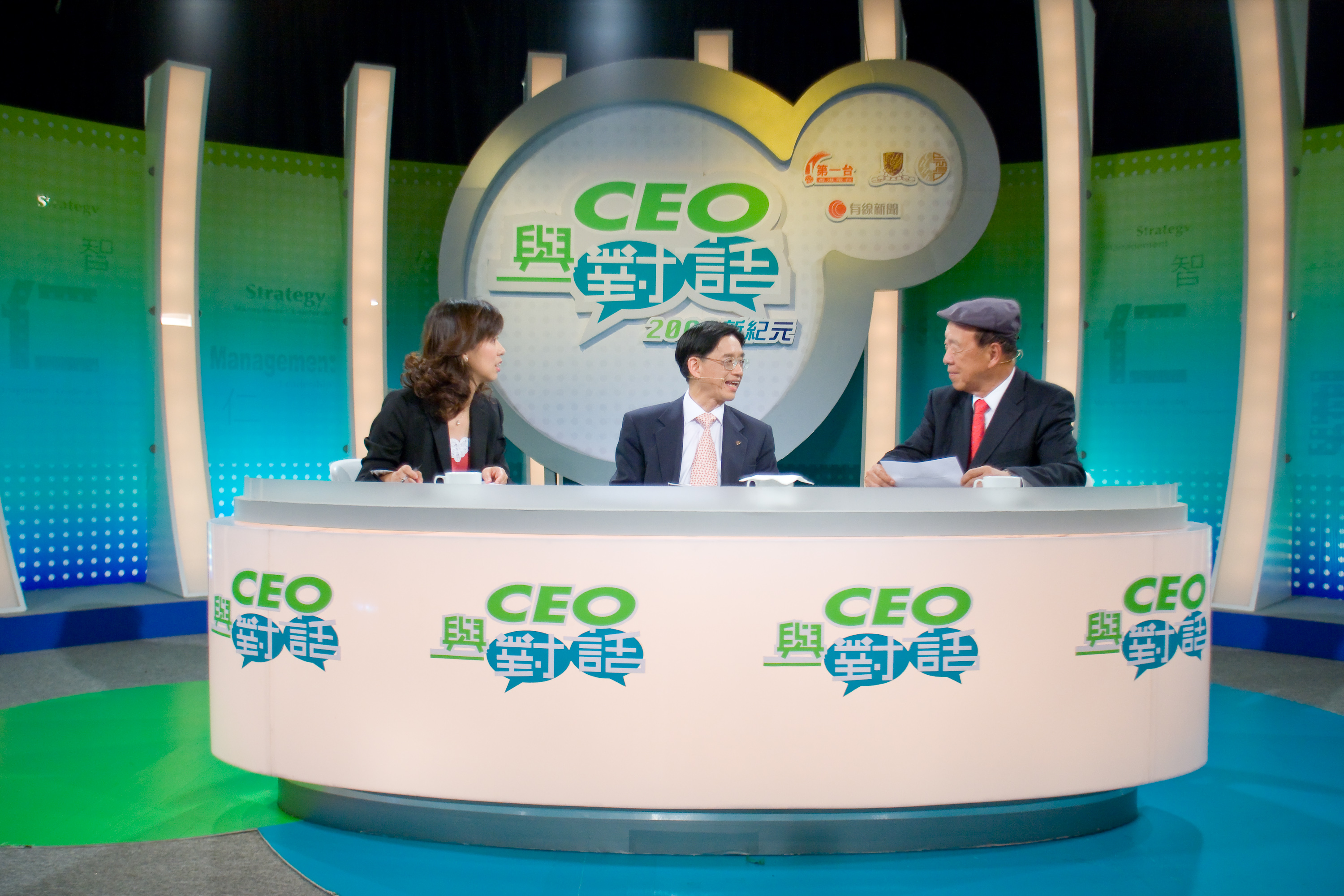
Dialogue with Dr Lui Che-woo
24 June 2008
Lui: Dr Lui Che-woo
Chan: Professor Andrew Chan (host)
Wai: Echo Wai (host)
Introduction
Wai: Welcome everybody to “Talking to CEO”. Our guest today is truly extraordinary.
Chan: Coming from a modest family background, he had little capital to start with, but nevertheless succeeded in new business ventures, credit to his shrewdness and hard work. Over the years he has continued to keep up with new developments in the market and make innovative moves. He persists in what he does, in some cases despite the disapproval from people around him. Often, he is proved to be correct.
Wai: Welcome, Dr Lui.
Chan: I remember meeting Dr Lui for the first time at K. Wah Centre. We went up the elevator together, you to your office on the 29th floor and I to the Consumer Council on the 22nd floor. [*Professor Chan was Chairman of the Consumer Council for 6 years.] Dr Lui was also actively involved in initiatives to assist the development of tourism, hence we subsequently met on many occasions, such as at the activities of the Hong Kong Tourism Board (HKTB). I was very impressed by the wise thoughts he showed during our conversations, hence I invited him to host sharing sessions with our students. That was 4 years ago. Although Dr Lui is an extremely busy man, he is also a man of his word, who always honours the promises he made.
Refusing a generous tip
Wai: Before we start the discussion, I would like to share a story. A young man was learning auto parts trading under the auspices of a relative. On one occasion, he ordered some auto parts for a client, who ended up making a handsome profit. The client offered him $200 as reward. How would you respond if you were the young man? Comments from the floor are welcome.
Lui: We are talking about monthly salaries of $50 or so in the post-war years.
Chan Chun-hung (陳春雄): I suppose there are different approaches in different generations. It was probably acceptable for him to retain it, according to the practice in those days. The practice in the present day is different, as this reward should probably be reverted to the company, on whose behalf he is working. After reporting it to the company, I suppose the company would use the amount for the benefit of the staff, such as sponsoring lucky draw at the staff annual dinner.
Chan: ICAC’s regulations in this regard are roughly like this. If the employer knows in advance that you will receive a tip, as in the case of a hotel bellboy, it is permissible for the employee to accept that reward. But it would also depend on the amount, and whether additional services are required in exchange for that reward. A reward paid in exchange for additional services is not acceptable. You answered well.
Wai: Why don’t we ask the “young man” in question?
Lui: I was about 20 at the time with a monthly salary of about $50. I was taken by surprise, as I thought any extra reward was unwarranted since I had been paid to do the job. So I refused. He persuaded me to accept it, but duly obliged when I insisted on not taking, though he in turn looked a bit surprised. After 5 or 6 years, he took the initiative to offer assistance when I started my own business.
Chan: It didn’t occur to you when you refused that he would help you one day, did it?
Lui: Never. I thought it’s my duty to do the job and the offer of the reward actually gave me an impression that the client didn’t appreciate my work and thought I would only work with my best endeavour for extra rewards.
Against popular advice: Office tower in North Point and Hotel in Tsimshatsui East
Chan: We paid a visit to you at K. Wah Centre this afternoon to discuss arrangements for the programme. Before you built K. Wah Centre, there was no similar commercial buildings in the area near North Point Pier. Had anyone said things like “Nobody is going to rent your units if you build an office tower here” ?
Lui: I believed North Point was going to develop into a business district because of its harbour access. If I were to build a tower, I could at least use it as our own office. Admittedly, this was a bold decision, because I was the only one then constructing an office tower in North Point, a neighbourhood of little commercial presence at the time. Now there are about 20 office towers in the district, which justifies my decision then.
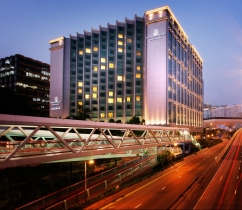
Wai: Is this boldness a hallmark of your business ventures? The construction of InterContinental Grand Stanford Hong Kong in Tsimshatsui East was probably a similar story, wasn’t it?
Chan: That was a piece of barren land back then. Did anyone advise against it?
Lui: People called me a fool. They thought it’s just vanity, as the hotel business was not profitable at all. But I was determined to build a hotel because sites with sea views were rare in Tsimshatsui. Of course I was a bit worried, too, for I had never run a hotel before. I believed I must hire professionals to operate the hotel. So I negotiated with groups such as Hyatt and Peninsula. In retrospect, I was very bold to have signed management and franchise contracts that offered little protection for my rights. But I was certain that Hong Kong would develop into an international city in the future, so I must improve the quality of the hotel by adopting advanced management approaches employed by other international hotels.
Chan: How many years ago was that?
Lui: We started contract negotiations in 1978 and the hotel opened in 1980.
Chan: But why the hotel? Many people believed that it was the property sector that would make one rich, not the hotel sector. Why would you think otherwise?
Lui: Professor Chan, you hit right at the point. That’s exactly the criticism I faced. People engaged in property development can recoup their investment by selling the flats immediately after completion. The operation of a hotel, on the other hand, requires long-term planning and management. But I felt that this was a site with a rare sea view. Once I decided to build a hotel on it, I must employ professionals which would help to develop this business into an international operation.
Surviving the war and started foodstuff business at mid-teen
Wai: The first two questions of Professor Chan have more than highlighted the character of Dr Lui. Once he has decided to invest in a project, he would go all the way to the end, regardless of any disapproving views that others might have.
Dr Lui’s mega-size corporation started as a small business he ran during his mid-teen years. Dr Lui was deprived of schooling during childhood because of the war. Instead, he learned to do business under the auspices of a relative. Is it true that your aspirations in business go back to your teenage years?
Lui: I am not sure I know the answer to that. Food supply was scarce during wartime, so I started to do some food catering business at the age of 13, hoping to prevent my family from starving. At that time my father was working in the garment business, so I didn’t know how to cook. I could only learn as I worked, following others’ examples at times while also inventing my own dishes.
Chan: There was a media report on you entitled “The Story of Making Sachima” which really puzzled me. The sachima usually takes a long time to make, but you seemed to have a secret recipe. Would you care to explain?
Lui: So you have discovered my secret! My family had never been in the food business, so I had to come up with something new from time to time, otherwise my customers would be bored. I made peanut candies, ginger candies, and a few more items. Oil and flour were scarce in supply at that time, but when I found some dried Shahe vermicelli in the market, it occurred to me that I might put the dried Shahe vermicelli on heated sea sand so that the vermicelli would burst. Add some syrup on top and you have a sachima. I thought it’s amazing.
Chan: How did you come up with that method?
Lui: Honestly I have no idea.
Chan: Didn’t your family raise any issue with your involvement in food making?
Lui: My grandmother and my mother did some family food business on a wholesale basis during the war. When I started to do my own food business, it was also on a wholesale rather than retail basis. The products were usually sold to workers of The Wharf.
Turning to auto parts dealing at age 20
Wai: Dr Lui ran a wholesale business during his mid-teen and had earned his first pot of gold by the age of 20. You were talented and creative in food making. In the 1950s you assisted your uncle in his auto parts dealing business, before turning to quarrying…
Lui: Not that fast. My uncle owned an auto parts company in joint venture with some partners, and I worked as a warehouse keeper there. I was responsible for checking the inventory, so I knew very well how the auto parts were selling. I asked my uncle to order more auto parts which commanded higher sales and I paid for these orders, as I had some savings from my food catering business.
Chan: Didn’t your uncle know which products were selling? Why didn’t he make the purchase decisions himself?
Lui: Well it’s difficult to explain. Perhaps our talents were different.
Chan: This was the approach of your joint venture?
Lui: It was not really a joint venture. The most important thing is to seize opportunities when they arise. I was determined to invest because I knew some auto parts were selling well. My uncle was a conservative man, so I took the responsibility of making decisions.
Inspiring by Okinawa to start quarry business
Wai: So how did you change from auto parts business to construction materials business?
Lui: In a short span of two years, I became the owner of the auto parts company. The shop was located at 742 Nathan Road with a GFA of approximately 2000 square feet, and I was only 22 to 23 years old. Later, when I learned that the government was putting up some cranes for auction, I thought the building industry could use these cranes, which were not available in Hong Kong at that time.
Incidentally, I became acquainted with a Japanese during that time. He studied at Waseda University and had some connections in Okinawa. I figured the U.S. army would have left a lot of surplus supplies in Okinawa, such as auto parts. When we did get to Okinawa, we found that a lot of second-hand cranes were put up for sale. I believed these machineries would be very useful for Hong Kong’s future development, so I bought them and shipped them back to Hong Kong, and started my quarrying and construction materials business with them.
The cranes bought in Okinawa were much larger in size than those sold by the Hong Kong government. As a result, I was able to undertake 80% of the infrastructure projects conducted along Kwun Tong, Lok Fu, Sau Mau Ping and Lam Tin.
Wai: Before that, quarrying in Hong Kong was done manually by using simple and primitive tools. Did the introduction of the heavy machinery chang the development of quarry business in Hong Kong?
Lui: Yes, there had always been quarrying activities. The entire industrial estate district in Kwun Tong was created out of reclamation using rocks excavated from such quarries. At first it was done manually, and casualties were frequently reported.
I believe the import of heavy machinery was an innovative move. It has indeed contributed to the avoidance of casualties, while directing me to the quarrying and construction materials industry.
Chan: You went to Okinawa to purchase auto parts as a dealer. Instead, you discovered some mining machinery and brought them back to Hong Kong. This tells two things about you: First, you are good at grasping opportunities. When you saw those machineries, you immediately planned to tap into a new business. Second, you are good at digesting information. You were in the auto parts business, yet you had knowledge about quarrying.
What I want to point out is that, we should never be bounded by one industry, such that we miss chances when they come by. When we come across new things that would be positive to Hong Kong’s development, we should try to introduce them.
Lui: I found out that these machineries would be very useful for Hong Kong’s land development, so I brought them back. Subsequently they became so popular that I ran out of stock, as they were needed in quarrying, bulldozing and dredging, etc.
Fencing off an Australian quarrying operator
Wai: Next I would like to ask about competition in the quarry business. There were so many quarries in Hong Kong during the 1960s and 1970s. Why was Dr. Lui’s business particularly successful?
Lui: At that time there were about 70 quarrying operators in Hong Kong, all operated in rather primitive ways. By using heavy machines, I was able to reduce costs and increase the quality as well as quantity of our production. As a result, we drove other quarry out of business.
Wai: You were superior to other local quarry operators in terms of machinery. But how about foreign competitors? How did you out-compete them?
Lui: This happened many years later. A famous global brand came to Hong Kong to compete for the cement market through price wars, seizing market shares from us. However, I believe that, with perseverance and the right vision, we need not be intimidated by the financial strength of our competitors. In the end, the chairman and the CEO of that Australian company came to see me in Hong Kong to ask for a truce.
Chan: Can you tell us more about this story?
Lui: They thought they could defeat us with their international brand reputation. But I had done my calculations. In the event of a price war, their loss would be 4 times as much as ours, owing to their higher operating costs. If we conducted ourselves even more stringently, then the multiple might go up to 5 or 6 times. It was war and we must act fast. To save time, I asked my staff to carry the contract copies with them and authorised them to sign up whatever deals they would come across without consulting me. In case of a large project for which the client would prefer a company with international brand reputation, we would quote an excessively low price, forcing our international competitor to lower its prices as well. In the end, the competitor booked losses of more than $30 million, and their chairman and CEO came all the way from Australia to make a truce with us, a small local company. At that time, my company was managed by an Australian, who said he had never seen this from happening before, and even conceded that the glory of victory felt better than a pay raise.
Chan: Let me put in some more background information known to me. You must gear up, because an international corporation was making a move to compete with you. You decided to take small orders at normal prices, as the competitor was not interested in small orders. For large orders, you tried to compete with low prices. As the competitor was invariably subject to high management cost as a large-scale company, they would have been susceptible to losses had they accepted the contract. Moreover, Mr. Lui’s company was small in scale and he could make decisions quickly. An international company was less flexible and therefore disadvantaged in competition. How did you come up with this idea? You were not well educated, and certainly hadn’t studied for the MBA.
Lui: There was no MBA for me 30 years ago. It was the only option as I reacted to the situation.
Wai: By the time you started the concrete and construction materials business, you had employed many staff with specialised expertise and delegated the operations to them. Have you been able to trust your colleagues?
Lui: The modern CEO dictates financial matters and the overall direction only. Operations and production must be handled by professionals. This is a global trend. My hotels, for example, are all managed by professionals.
Chan: Many chairmen and CEOs are unwilling to let go. When their subordinates make mistakes, they couldn’t help to resume control. How about you?
Lui: My employees have less experience in the business compared to myself, so they are bound to be less efficient. But we must give them the opportunity to try, and bail them out only when things go awry.
Chan: So management is a form of education.
Lui: Yes, education is a necessary process.
Wai: If a business is to be run with uninterrupted succession, there must be a process of educating the employees. The forum is now open to the floor. Questions are welcome.
Mitigating risks in venturous projects
Wan Tze-wai (尹子威): Dr. Lui is a pioneer in many areas and often needs to take risks, especially in relation to financial arrangements. But you seem to have steered through smoothly and succeed every time. How can we do likewise?
Lui: If you want to succeed, you must be willing to take risks, which means you would most certainly incur loss. The question is how to minimise such loss. Timing is an important factor. Whether to embark on a new business or to abandon it is a judgement that has to be made based on experience and business acumen.
Chan: If you have taken Professor Min Kun-chok’s course, you would know the importance of timing and placement, and that you must seize the chance while you can. The purpose of these CEO seminars is to investigate how we could seize chances accurately. This is also dependent on one’s astuteness and vision of what’s happening around us in the world. Had Dr. Lui been only focused on auto parts without knowledge of the government’s sale of cranes, he would have missed that opportunity for success.
Lo Wai-kwan (羅煒羣): Dr Lui, it strikes me that you are very concerned about the world and other people, as you wanted to reduce casualties at the quarries by using machinery. I would like to ask whether you have considered the consequences each time before taking risks?
Lui: We could not avoid taking risks. When we make choices, deep down in us there must be a vision. We could even invest in a sunset industry, if we have ways to reinvent or re-energise it. Otherwise we’d better leave our money at the bank to accrue interests.
Wai: Before the break, we would like to dedicate a song to Dr Lui.
Ng Yee-hang (吳義恆): Dr Lui, warmest greetings. Your unique vision, perseverance, and calmness in the face of challenges and opportunities are some of the things that we must learn from you. We would like to dedicate this song to you and we hope you like it: Roman Tam’s A Prosperous Future (《前程錦繡》).
Property disposal in 1997 and land application after the financial crisis
Chan: Why did you sell your properties in 1997?
Lui: The value of assets fluctuates, so we must seize the right timing to buy or to sell. Giving the conditions in 1997, should we have bought, held or sold? We must analyse the future and choose to hold if we are positive about the prospects. However, if we have made a profit and have concerns in liquidity, we should consider offloading.
Chan: Did you feel a sense of loss after the disposal?
Lui: The moment a businessman acquires a project, he should be at the same time pondering when to sell it, unless there is somehow an emotional attachment to it. Our hotel in Tsimshatsui was opened 30 years ago in 1980 after I had acquired the site in the late 1970s. I personally handled the entire process from land acquisition, construction to negotiation with foreign hotel management groups. In 1985, the general manager of Hang Seng Bank told me that someone was willing to buy my hotel for HK$2.5 billion. But it happened that I liked this hotel very much and I was not in urgent need to cash in, not to mention that it was generating an annual income of HK$100 million. Hence I didn’t sell it. However, I did sell 2 or 3 other gorgeous buildings which I was not particularly fond of and which had generated cash for us. Doing business is about nurturing strengths and leveraging them properly. Use them the wrong way and you would incur losses.
Wai: Was K. Wah’s business affected in any way amidst the instability in the wake of the financial crisis?
Lui: I was well-known for my bullish outlook in those days, making moves in land application and acquisition. It was indeed a bold move, for we were just a small- to mid-cap company at the time. Now we are of course a mid- to large-cap company. We bought with the belief that the properties will grow in value, and on the basis of sufficient liquidity. A businessman won’t fail if he is able to perceive future changes and understand where his strengths lie.
Business development in Mainland China not about making profit
Chan: Entering Mainland China was another high point in your business ventures. During the 1990s, many people were not very sure about investing in China, because of their lack of knowledge of the China market. You, however, launched projects in Guangzhou and Shanghai. How did you come to determine that the 1990s was the right time to tap the China market?
Lui: The considerations have not been merely commercial. I returned to Mainland China out of patriotism as a Chinese, so the objective was not necessarily to make profit. When my children went abroad to further their studies, things in China were rather chaotic. I told them they were among the luckiest Chinese for the opportunity to study abroad, and that I was sending them abroad on one condition: that they would return to serve Hong Kong or Mainland China after graduation. They duly obliged and subsequently returned to work in Hong Kong or, if I requested, the Mainland. Several of them are now serving as members of the Chinese People’s Political Consultative Conference (CPPCC).
Chan: How did you conduct yourself in parental education? The kind of obedience shown by your children is rare to see these days.
Lui: I taught by example. They knew that their father had been working very hard over the years, so they too had to be hard working.
Chan: Yes, teaching by example is the golden rule. Your children were glad to help when they knew it was your wish to develop business in the Mainland.
Hiring professionals to facilitate business expansion
Chan: You had never been involved in the entertainment business and you knew very little about it. Why were you bold enough to make that investment? What happened to the traditional Chinese advice of staying away from businesses we don’t know?
Lui: I have been involved in many businesses before, so I understand that I cannot do everything on my own. We need to engage professionals. I employed several Westerners in my construction materials business during the early years. Today there are as many as 20 expatriates among the management of the hotel business in Macau. Professionals are engaged in all relevant segments, such as finance, gaming, mechanical operations, decoration, marketing and future planning. I shouldn’t exhaust myself in these areas, but should instead rely on professionals to facilitate business development.
Chan: You mentioned an Australian staff at your quarry who was happy to work for you. How did you get to know him and secure his service? It is customary for Chinese to look among acquaintances for employees. Why were you willing to appoint a foreigner?
Lui: Because they were better than Chinese in terms of management and technical skills, owing to China’s closed-door policy in the past.
Chan: How did you convince him to leave his homeland and come to a small place like Hong Kong to join your company, which was still a small business at that time?
Lui: We gave him a good salary and the opportunity to do what he was proficient in. He had fond memories here and visited Hong Kong very often after his retirement.
Distinguishing the Company from its competition in Macau’s entertainment business
Wai: Your StarWorld Hotel and casinos in Macau are facing competition from global players. How do you position yourself and seek to out-compete others?
Lui: This is really World War II again for me. An enormous challenge indeed. Our principle is to operate with pragmatism. We try to control our investment and reduce costs by seeking maximum gains with minimum inputs, unlike our foreign competitors who tend to be extravagant in style. Secondly, we as Chinese have more amiable relations with our staff and fellow Chinese, and we don’t easily resort to measures such as redundancy as our foreign counterparts do. It’s premature to say who will win in the end. Wynn, Venetian, MGM, and Crown all belong to the elite group in this industry, while SJM has been around in Macau for more than 40 years. Maybe you can give me some good advice?
Chan: MICE is a key term in tourism in recent years. It means Meeting, Incentive, Convention and Exhibition. If every large-scale international corporation is developing MICE and competes with each other in a small market, what does a company need to do in order to stand above the rest?
Lui: MICE has not been highly regarded until the last two years, but I was convinced back in 1997 that this would be the focus for the future. I discussed with the government leadership about the ways to explore the convention and exhibition market, and ways to optimise our tourism sector in this connection. It was not until two or three years ago that the designation of “MICE” became popular. Two years ago, I was invited by Singapore to share my views on MICE. Subsequently, I proposed a further “E” in addition to MICE, and that’s “Entertainment”, which included dining. I believed this would increase the potential of the sector. Macau is currently making a major effort in the development of MICE, and I think this is also the right path for Hong Kong going forward. It is one sector that worth strong development efforts following finance, trade and logistics. Hong Kong people’s spending power has been undermined by inflation. Employees need higher income to sustain their living standards, and companies could only afford salary raises if Hong Kong in general is earning more revenue. We could do that by improving our facilities to attract more tourists, especially business travelers, and MICE would be more than conducive to our purposes. A few months ago, the Hong Kong Government expressed its intention to commit major efforts to the development of MICE. Hong Kong is blessed with a strategic geographic location supported by comprehensive transportation access. We have always enjoyed strong international reputation on the back of sound administration and an ample supply of high-calibre personnel. I believe the income for our fellow citizens will improve in the future if we implement the aforesaid plans.
Chan: Let’s talk about the 5th E – Entertainment. Have you added the element of entertainment in your properties?
Lui: You all know I am running a small project at Lei King Wan in Sai Wan Ho, setting up open-door dining facilities (premises without gates or doors) along the harbour front. The project, now known as SOHO east, has been in operation for more than 10 years, and has been quite successful. The current government proposal to build corridors along the harbour front is based on the same idea. Similar open-door diners can now be found at Empire Centre and Tsimshatsui Centre in Tsimshatsui East, which are dining facilities with an entertainment element. The government is now more accommodating about open-door or open-air restaurants, as the officials also see the necessity of developing MICE.
As for our hotels in Macau, we have also enhanced the entertainment feature in order to distinguish ourselves from the rest. Our blueprint for Taipa has been designed taking into account the practices and needs of Asians, and includes rendezvous for family gatherings, surfing sites, and even a small chapel for weddings. We are designed to be an ideal destination for family gatherings and business meetings, rather than pure gaming facilities, as there are also medium-size conference rooms each with capacity of more than 300 persons. We have developed many non-gambling projects, as we don’t want Macau to be identified with the gaming industry only.
Property development in Mainland China focused on tier-one cities
Wai: In Macau, Galaxy Entertainment Group is known for blending Asian characteristics and Western management methods. In Mainland China, aggressive new property companies have been emerging to compete with K. Wah. How do you respond to that?
Lui: The situations are different in Hong Kong and the Mainland. Buildings in Hong Kong are constructed on the basis of Hong Kong’s safety factor, whereas buildings in the Mainland are targeted at lower to middle classes. To be fair, Mainland developers have been doing a great job with much success. China is a vast country and there are many cities which have yet to be developed. I believe that Mainland developers and Hong Kong developers have yet to be engaged in direct competition.
Chan: Each would focus on what it does best. I suppose you are focused on major cities?
Lui: Yes, our developments are mainly located in Guangzhou, Shanghai and Beijing. We do not go to remote tier-two or tier-three cities. Although the land prices and buildings costs there would be lower, but we should not attempt to cover the entire market of 1.3 billion people. Focusing on one segment is quite sufficient. There is no need to compete for smaller cities.
Educational donations in Mainland China
Chan: Dr Lui knows how to make choices. He won’t make unwarranted expansion.
Let’s talk about another area. I didn’t know Mr Lui through K. Wah Group. I became acquainted with him because he had been significantly involved in education-related charitable activities. So, as an entrepreneur, why are you so interested in education?
Lui: The reason is simple. I stopped going to school after the first year in secondary school. After that I only attended evening colleges from time to time. When I was young, I saw people raising funds in the streets following the Marco Polo Bridge (“Lukouqiao”) Incident, and I still remember how they exclaimed that all Chinese are illiterates. Now that I have taken from the society and made a fortune, it’s only right that I give back and support education, especially primary education. Over the past two to three years, I have made donations to build close to 200 primary schools. When Wuyi University was founded, I made donations to fund the construction of three teaching blocks. Most recently I made a donation to their business school, as I believe that China is in need of management professionals. On another occasion, I donated 300 sets of computers to Fudan University after seeing students wait in long queues for the use of computers, followed by another 200 sets when we found the first donation was not sufficient. This happened many years ago, and I clearly remember asking the university what computers they would prefer. Lenovo would have been the cheapest with the largest network of service outlets. The students, however, preferred IBM, which required the separate purchase of accessories. It’s fine for me and so it’s IBM. I also made donations for the construction of the largest hall in Fudan. A nation rises to greatness only through successful education, where elites are trained by brilliant teachers. I have met many aspiring primary school teachers in the Mainland whose goals have been left unfulfilled because of the lack of hardware facilities. Hence I would like to make some contributions in education.
Chan: The universities in Hong Kong could also help, not financially, but in terms of ideas or supporting services. Your support for education is also a way to teach by example. Lip-service can hardly help. Those who are financially capable should make monetary donations, while others should also contribute in their own ways.
Wai: I have another question for Dr Lui. What other aspirations do you have, since you have a happy family and your business is doing well?
Lui: Over the years I have experienced hardships as well as successes. Now my only hope is to enjoy life in the way I like and leave the troubles to the younger ones or professionals. This is my wish, although I am not sure whether it can be realised.
Chan: Can you go on holiday for one week without taking phone calls? I don’t think you can.
Lui: No indeed. It would be very difficult for me to do that.
Wai: So your wish is to take a one-week leave. Right, let’s move on to Q&A time.
An “easy-minded” approach in interpersonal relations
Cheng Man-shan (鄭文珊): Thank you for sharing your philosophy of life. We have certainly benefited much. I remember another fruitful dialogue with you held at your hotel, as part of an EMBA group led by Professor Min and Professor Chan. I have a question: your children are working at the Group, while you also employ other professionals. How do you resolve the potential conflict between them and foster staff loyalty among these professionals?
Lui: This is indeed a difficult question to answer. Yes, there have been difficulties, because of generation gap, and because of the gap between family members and professionals. It’s not easy to get them working together. Even nowadays, I find it difficult to take a leave from work. Interpersonal relations could be the most difficult issue to tackle in life. My take is that we should face it with an easy mind. If you achieve 40% to 50% of your goals, you should consider yourself successful. In this way, you will become a more tolerant person. You would be driving yourself too hard if you always expect more than 80 marks out of 100.
Chan: Let me try to answer this question, too. The key is continuous growth. If the company keeps on growing, manpower would always be tight and staff would be too busy for any interpersonal conflicts.
Lui: The professor is very wise indeed. It’s true that expansion would help alleviating this problem, but the problem won’t be altogether solved. And we could only expand if the chance is right.
Chan: At the end of the day, the job should be given to whoever is capable. I once asked Mr Victor Fung (馮國經) whether his successor had to be a member of the Fung family. He conceded that there was no point in forcing the issue if the younger family members are not up to it. Hence we should be easy-minded about this. We should give the second generation opportunities. If it doesn’t work, we should let capable people do the job.
Lui: I agree that this is the best way. I am also well-acquainted with Victor, and I also knew his father Fung Hon-chu (馮漢柱). In short, the boss must deal with the problem of generation gap and cooperation with an easy-minded approach if he wants fewer headaches.
“Don’t remember having failed”
Chan Yiu-wah (陳耀華): Dr. Lui has shared many success stories. Were there any examples of failures?
Lui: Failures… there seems to be none. There have been setbacks for sure, but no failures. If we are able to capitalise on the right opportunity and choose projects which are within our ability, we would at most suffer setbacks, but never total loss. Let me share about a setback I experienced. During the 1970s, I acquired a quarry at a price of over $160 million, only for the government to develop another quarry at Shun Lee and sub-contract the operation of stone crushing facilities to a third party. So this company paid nothing but instead received a contract fee from the government to do the same business which I had to pay $160 million for. The competitor enjoyed a cost advantage from the outset. So what should I do? I delegated all decision-making of the project to the senior management and retained only a supervisory role. My contract with the government stipulated that we must produce a certain volume each month, so I must find buyers. When the foreign manufacturer mentioned in the foregoing learned that we were in trouble, they wanted to orchestrate a buyout. They proposed a contract to buy 300,000 tonnes each month, equivalent to one third of the volume we had undertaken to produce in our contract with the government. The contract also stipulated their right to take over my quarry in the event of any financial difficulties or inability to carry on the production. I almost signed that contract, but I didn’t. This manufacturer was engaged in the production of wet cement. Instead of supplying dried cement to it, I decided that I would also produce wet cement to compete, on the back of our cost advantage. And the rest of the story has been told. In the event of any setback, we must persevere and control cost. But this was quite an alarming experience.
Wai: Dr. Lui doesn’t think about failures, because he is able to achieve turnarounds. You would inevitably face setbacks in business. The question is whether you can persevere and reverse the situation.
Lui: It is almost impossible to steer through difficulties without the help of syndicates. At that time, one of such syndicates offered to help because they trusted me, and I repaid the loan in full after one year or so. People wouldn’t have been willing to help if I had not demonstrated myself as a pragmatic and trustworthy person.
Wai: Thank you, Dr Lui, for sharing with us today. Professor Chan would like to dedicate a song to you.
Chan: It’s called “Be Strong As A Man Should Be” (《男兒當自強》). Actually, everyone should try to gear up and take himself or herself to another level, regardless of gender. It’s not difficult to be CEO during plain sails, but the true leader only reveals his or her qualities in times of adversity. There are difficulties aplenty, but the most difficult of all is to foster a corporate style. Every move or decision of the company is being scrutinised by the public and could have a decisive impact on whether it would succeed or fail. Here to the song, thank you.
Lui: Thank you.