



.jpg)



Speeches and Transcripts
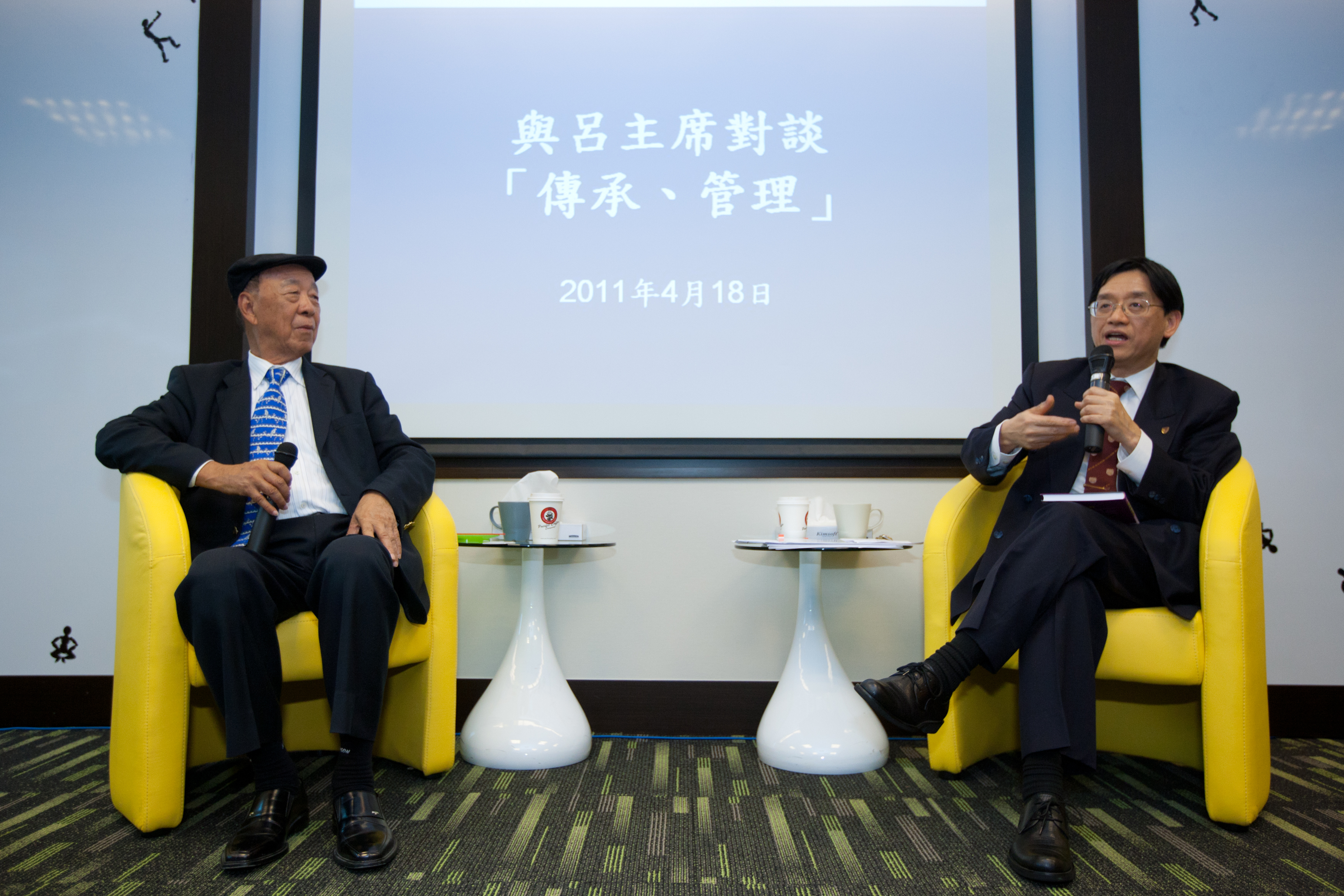
Dialogue with Dr. Lui on “Succession and Management”
Dialogue with Dr. Lui on “Succession and Management”
Date: 18 April 2011
Venue: 12/F, K. Wah Centre
Chan: Professor Andrew Chan Lui: Dr. Che-woo Lui
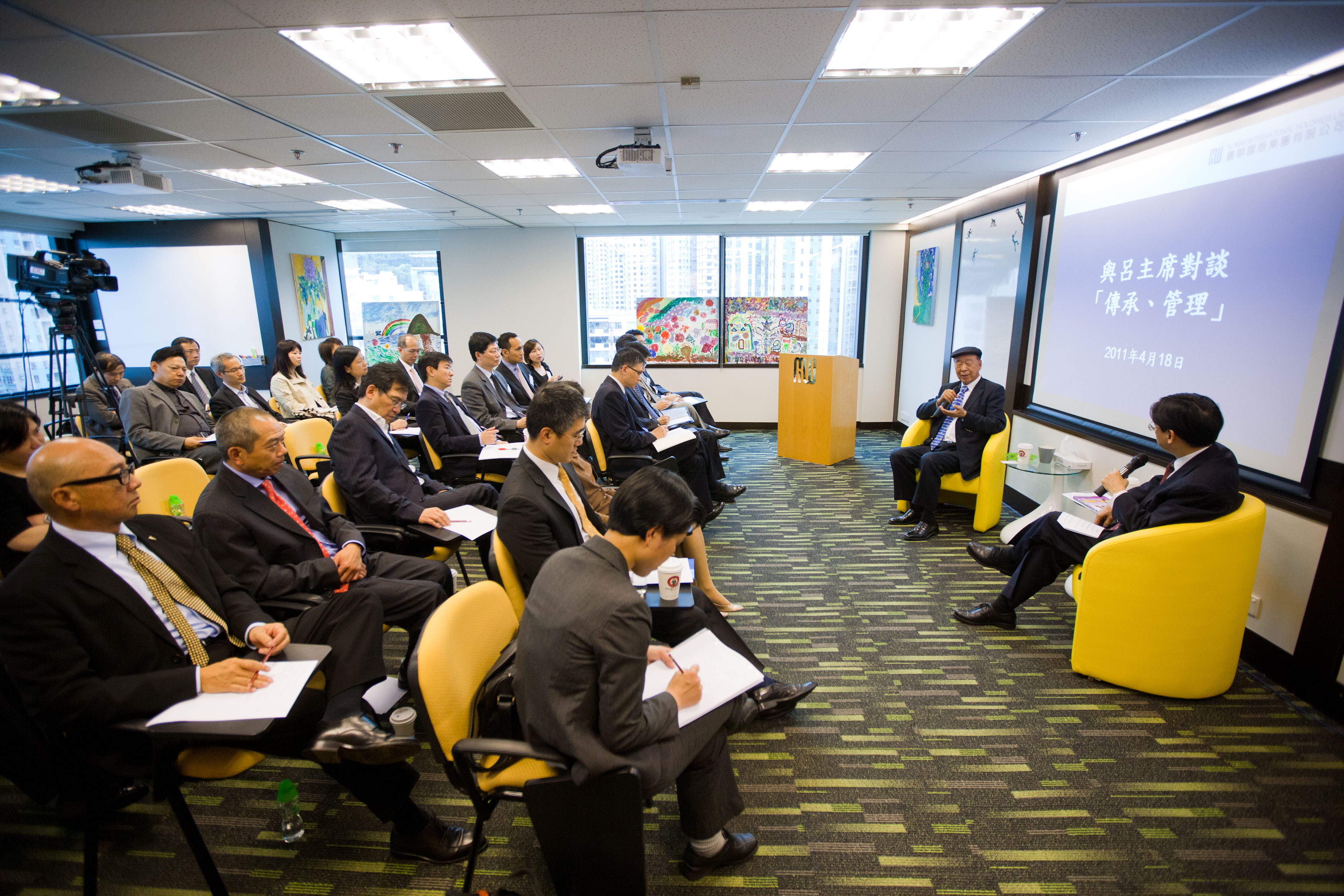
Chan: It gives me great pleasure to come here today. Dr. Lui had plans for this event as early as six months ago, when we met to discuss its aims and objectives. Dr. Lui has singled out “management succession” as an important issue that he has been considering for some time, as management succession cannot be achieved overnight and there are many things that need to be taken into consideration. In view of this, Dr. Lui proposed to organize a forum where we can discuss and interact, which should be more useful than the one-way communication afforded by talks and speeches. He also suggested that EMBA students should be invited to participate, and we duly obliged. Hence the presence of some of our community’s best people here today.
Let me start with a question straight away. Dr. Lui frequently talks about management succession and the delegation of power, but this is not an easy thing to do. Power mesmerizes. Like money, you will never have enough of it. People would like think about how to become more powerful, not how to surrender power. Why are you so keen on this topic, Dr. Lui? What are your views on management succession and the delegation of power?
Lui: Professor Chan has started off with a really difficult question for me. In general, business management is concerned with how to make money and how to manage a business. I talked with Professor Chan the other day about how to carry on a business. Succession is a difficult thing to realize in a Chinese society. Throughout history, kings, generals, warlords and business magnates have tried in vain to ensure succession. In modern times, fortunately for us, succession is enjoying greater protection by laws, rules and regulations in Western countries. There is a Chinese saying: “It’s rare for a family fortune to last for more than three generations.” Every family or company would like to see its merits and establishments become a lasting legacy. In this regards, I believe the advances in modern transportation and network facilities will facilitate more effective succession. What do you think, Professor?
Chan: As far as I am concerned, succession is based on the understanding that no one lives forever and the business has to be passed on to someone else sooner and later. The question is: Why do we always feel it difficult to entrust it to other people? That’s because we are worried he or she might not know what I want, or how to achieve what I want. Take my EMBA programme for example, whom should I pass it on to? I need to find the right person, and then spend time observing him or her while getting my ideas across. Is EMBA aimed at profit making or the training of people? It is the thoughts and ideas within me that need to be passed on and succeeded. Dr. Lui, what are the qualities in K. Wah that you wish to be carried on?
Lui: I started from zero to take the company to this far. What I have been counting on are hard work, innovations in business approaches and the ability to capitalize on opportunities. I also count on my children and colleagues to help me achieve my aim. For us, the essence of succession is to pass on our experience in hard work to achieve success against adversities, and to identify the right successor. Professor, I acknowledge that this is a difficult but unavoidable task. That’s why we have organized this forum today and would like to hear what you have to say on this issue.
Chan: So Dr. Lui has got me here to answer questions, not to ask them. The most difficult part, I believe, is to identify people whose character fits into the culture of the company. For example, you said you were committed to strong efforts. How should the company guide employees of such caliber to understand that their efforts are going to pay off both for themselves and the company? If the company is able to do this, the employees will give it all knowing that they have the support of the company. In the case of K. Wah, its efforts have always been made in close tandem with the needs of the society. For example, you bought machinery from Okinawa and apply military equipment in quarrying operations. Ultimately, it was for the sake of the construction of roads and buildings, and the use of machines helped to reduce the chance of workers’ injuries in the process. In other words, your move to buy the machines in Okinawa was constructive for the society and the world. The people you pick and train must fit into your favored approach of hard work and innovative ventures. As we all know, while you have established a handful of new ventures by now, you have risen to prominence through humble beginnings and have had your share of hard times. So my answer to your question is: I will look for firstly commitment to hard work willingness and secondly creativity. How have you located your staff? Has it been difficult?
Lui: This underlies my biggest concern. If you look for hard work in someone, you must be ready to reward them commensurately. How can we identify people that are truly willing to help you so that you could pass on the business to them? How should we train these people? Even elite people have to be trained. We are not lacking people who show the intrinsic potential. The question is how we should identify, incentivize and nurture these people so that they are willing to devote their efforts for our purpose. This is one big question that I have wanted to ask you, Professor.
Chan: Let me share something about my small business with 7-8 employees. My colleagues are paid according to the salary scale of the university, so I cannot say that they are particularly well paid. We have one Executive Officer, one clerk and one trainee. But they are all very hardworking. The trainee, for example, was required to accompany the graduation class to Switzerland and Germany, etc. With a monthly salary of less than HK$10,000, he was extremely dedicated to his work, to the extent that at one point he didn’t mind crawling on the ground to take a picture for us. My approach is always to lead by example: I try to deal with any task that was within my ability and whenever my assistants see me doing something, they would step forward to complete it for me. It’s as simple as that. As a result, whenever the trainee comes across the students, he would help them with anything they need, and both would feel happy and contented. At times, my colleagues take the initiative to finish necessary tasks even before I have asked them to. How do you guide other people to follow your path?
Lui: As Professor Chan just said, some people are quite hardworking. They are even willing to clean up dirty drainage, while their reward might be very modest. Frankly, this kind of people is not hard to find. The difficult part is to train and nurture them and to impart in them a willingness to learn as they work. They must also have an easy going character so that they could work in harmony with others and secure the support of their colleagues. And this is only the first step. How do we pick out these people among the rest? It seems quite a difficult task for me, something that comes by chance rather than planning. Another Chinese saying goes: “It takes an experienced horse trainer to identify a good horse.” All in all, it is a complicated matter which involves many aspects. What do you think, Professor?
Chan: When I interview potential employees, I always ask them why they are interested in a job with EMBA. Most of them would answer that they have seen me in the newspapers or on the television or heard me on the radio, so they have a positive feeling about this company. So the reputation of a company is important for attracting high-caliber people who wish to join you in developing the company’s business. If you want the service of a high-caliber staff, you yourself have to command a high level of performance as well. What do you think, Dr. Lui? Is it true that high-caliber people tend to be attracted to companies with good performances?
Lui: The success of a company provides a visible target. As well as management succession, the pursuit of new business development must also continue. This holds true for every company, regardless of size and scale. From an organizational point of view, this is really a tricky task. We need to pick the cream and then commit resources to train them and encourage them through monetary rewards and promotions. The employees also need to work hard to learn. The company has to face a further problem of staff quitting after being trained up. These are difficulties to be overcome. Of course, there were also many examples in successful management succession, where the company’s business continued to grow; but there were also companies which filed bankruptcy subsequent to takeover by the second generation.
Chan: You probably have heard the name of Wang Computers. Wang An was a very capable businessman and the pride of the Chinese community. But the second generation was not able to carry on the business. I have some thoughts on the notion of “harmony” that we just mentioned. Harmony is a state of comfort and well-being. As a Chinese saying goes, “he who knows his destination feels settled.” If a person is not settled, it’s quite pointless to teach him anything. But the question is: how do you get the person to feel settled? While our company certainly has certain expectations for new employees, I would also try to understand their own aspirations and what kind of duties they would find themselves most comfortable with. I have this colleague who is very hard-working but does not like to deal with people. He likes to stay at the office, where he does very solid data research over the Internet and phone polls, but resents meetings with clients. His supervisor wanted to help him overcome this problem and get rid of the fear of personal encounters. My advice was that we should take time and let him settle in. Let him spend a few years in the present position so that he gains proficiency and satisfaction. Then we may consider broadening his scope. After he has settled in, he will be able to identify his right path and set off to co-develop with the company. Is this the way things are at K. Wah?
Lui: As you know, K. Wah has a history of 55 years and a staff headcount of over 20,000 people at the moment. There are many externally recruited professionals, who are very well-qualified, but inevitably there are some who are here because of family ties. Given things as they are now, the family element is a fundamental issue, but I do think that family ties are indispensable. Therefore we need to introduce reforms and investigate ways to train up people as reinforcements, and to ensure that they work with each other smoothly. I believe this is the most important part, as it is impossible for a company to be run by different types of people at the same time. These differing groups have to blend with each other in order to facilitate further development of the Company… That’s my thought in general.
Chan: In fact even this is not easy. People would tend to like that the Lui family is all powerful here, but a company with nearly 20,000 employees cannot possibly be run by just a few persons. There must be delegation, and the subordinate departments must be supportive. We need ways to encourage this support. Some people may think that they will never get a chance for promotion but, as Deng Xiaoping said, “development is the law of nature.” So long as there is development, there will be opportunities for everyone. So I believe this shouldn’t be an issue, as the ongoing nature of business development means that a company will only require more people than before. As long as a person is capable, the company should give him or her due recognition by way of both titles and monetary rewards. Paying employees according to market rates without allowing significant gaps is a way to show respect. My practice is to get the idea of “the boss knows it all” into the heads of the employees. Whether an employee reports directly to me or not, his or her work will ultimately come to my attention and he or she knows it. Is this difficult for K. Wah, with 20,000 staff?
Lui: At K. Wah, different businesses are managed in different ways. We don’t have a uniform management approach. On second thought, succession is a rather vague idea, easier said than done. Therefore I wonder if we should start from human resources. We need a well-defined system of reward and punishment and we need to identify staff with good potential. The capable people should be subject to further selections, for a person’s potential cannot be fully realized without competition, just as a footballer player cannot possibly bring his skills into play if there are no opponents on the field. To bring out the best of our employees, we must put in place a selection programme which helps our staff to identify their career objectives before training and incentivizing them. We need the human resource department to lead initiatives in this regard and carry on the process. We may lose some people in the course of selection, but at least we would have equipped them with proper skills, so that they will excel anywhere they go.
Chan: A few points relevant to what you just said have come to my mind. The key is: “appointment by merit only” (用人唯才), as opposed to “appointment by relationship only” (用人唯親). No matter how closely a person is related to you, you will do him more harm than benefit if you put him in a position beyond his ability. Moreover, fairness is always important. Be it a reward, punishment, promotion or dismissal, it’s important that everybody feels that the boss has been fair. Otherwise, the employees will feel frustrated. If we try to please everybody, we will end up pleasing no one. Of course, drawing a line between strictness and leniency is an art to be learned. Just then you mentioned the role of the human resources function. In fact, it all comes down to the system. People see a future in their work if there is a properly running system. I still remember your words in our last conversation: the biggest problem in the succession is the “lack of rules to follow” (無所適從). If the employee sees a clear prospect ahead supported by a sound personnel system, instead of a series of question marks, then he would tend to stay. What is it like now?
Lui: Based on what has been discussed, the human resources department has a vital role to play. The selection process requires meticulous work and is never easy. As Professor Chan just said, it’s a delicate path to tread when we try to roll out the process in a fair and equitable manner and convince the chosen candidates that they have a future here.
Chan: May I add that support from the boss or the management readily felt by employees is crucial to a sound personnel system. So it’s not up to the human resources department. Secondly, managing staff is not only the duty of the human resources department, for HR rules and regulations have to be implemented by all departments. The system will never work if the operating departments try to circumvent these rules. The talents and potentials of employees can only be fully realized if they compete on a fair ground. Dr. Lui, do you have any special means to retain capable staff?
Lui: In fact this is also a problem that disturbs me. There is no easy supervisory position. The decisions you have to make in a position: what to keep and what to give up, dealing with people in a friendly way or the hard way, etc, require very subtle considerations. The role of the human resources department is indispensable in this connection, but it will need the support and assistance of the management. Frankly, over the years there have been former employees who have done well elsewhere after leaving us, while those who have stayed behind have not necessarily been successful, as our company requires the service of a larger number of professionals with the ongoing expansion of its business, which complicates matter. I wish that succession could be managed in a simpler way, with a common goal. What I just said was concerned with succession at the intermediate level. I do hope to learn about how different companies around the world pick their successors at top levels.
Chan: This requires great wisdom, and the two cases are of course related. For example, if I only have Division 2 players when I intend to form a Division 1 football team, then I might as well give it up. However, I might not need all of them at Division 1 level, because firstly it would be too expensive and secondly a team entirely made up of top-class players might not gel. Take David Beckham for example, he was only in his mid-teens when he joined Manchester United, and he served the team loyally for many years. By the time he really matured, he was lured away by bigger monetary reward. But he still loved his club. In the same way, if an employee leaves K. Wah, he would still maintain friendly relations with the company, like those he would have with a distant relative in the neighborhood. Every time a colleague resigns, I would farewell him in smiles. I don’t want him to leave, but if he has to, I know that I can still turn to him when needed, and he will be ready to help. I am now the head of Shaw College. Many lecturers have transferred to the new college, although I have retained one. How did I do that? He is an expatriate professor who has been with Shaw College for over 10 years, and I have been here for more than 20 years. So we have known each other for a long time. A heavyweight of the new college invited him to transfer to the new college, and he found it difficult to turn down the offer, so he called me and told me about it. My response was like this: from the perspective of an ordinary person, it’s of course a great honor for you that a heavyweight has personally extended the invitation. However, I can tell you that there are still a lot of things and plans for which I need to count on your support, although it’s your call to stay put or move one. Three days later, he emailed the heavyweight to turn down the offer. I would say this is the way of the heart. Dr. Lui, I wonder whether the modern people would still adhere to the way of the heart. What do you think?
Lui: I have been talking too much. Why don’t we open it to the floor now? Anyone cares to shed some light for discussion?
Chan: Why don’t we ask the host to raise questions first? It’s a rare opportunity, so are there any questions? Before that, may I add one more remark: there are many who talk about succession but are reluctant to give up power when the moment of truth comes. I have a feeling that Dr. Lui is seriously considering delegation but is for the time incapable of doing so. Now please feel free to raise your questions... You are all so shy. Very well, in that case we’ll take questions from our graduation class first.
EMBA Student A: Good day, Dr. Lui. To me there are two aspects in succession. The first one is management succession, which we discussed earlier; the second one, as reflected in Dr. Lui’s remarks, is leadership in overall business direction, which is difficult to emulate. For example, your vision that guided you to purchase machinery in Okinawa. How can you teach that to the second generation?
Lui: Many young friends born in the 1980s and 1990s have asked the same question. In their view, doing business in the old days was easier, whereas today it is much more complicated, requiring different sorts of preparations and knowledge in a broad range of subjects, and the outcome is not necessarily profitable. I did fall short of an answer to this. I do admit that the world used to be simpler. Today it’s more complicated and there is more competition. All in all, there is one thing that we should learn after coming this far. I remember once when my granduncle [great-grandfather] invited me to dine at a restaurant. My mother ironed my best shirt for me for this occasion, where I was treated with Yangzhou noodles and other dim sums. Such food was considered expensive in those days. Today you probably won’t see any of our young friends getting excited about dim sums. The society has been changing; expectations are very different, and so are the things we do to meet those expectations. Therefore it all comes down to versatility: the ability to adapt and to create chances, instead of waiting for chances to come upon you. The society today is resourceful enough, so you can’t starve. Do some honest work and your turn will come by some day, though I cannot tell you how.
Chan: I would also like to respond this question, though I’m not sure if I can make you understand. It’s like you are a sophomore in the university and you complain that the exam questions are way too difficult compared to those you had when you were in the secondary school. So back in those years, it was difficult for them, too. They had no connections, no access to suppliers and capital. They earned what they had with their bare hands. For me, studying has always been difficult, whatever grade that might be. (Lui: I have to confess that studying during my time was easy, I just needed to recite the Trimetric Classic (“San Zi Jing”).) You think it’s easy? No wonder you have founded K. Wah whereas I have ended up teaching (laugh). Therefore it’s normal to feel that things are getting more difficult. What we should do is to embrace difficulties and deal with them in a fresh mentality. This is an important quality for succession. If all we know is to follow the crowd and say “yes” to the boss, we will never be able to open up new horizons for the company. What is your other question?
EMBA Student A: By far we have been talking about the second generation in succession. How about the third generation, which some companies are already training? Can you tell us about your policies in this regard?
Lui: To answer this question, we have to understand the traditional Chinese approach first. Chinese have always emphasized the family, so they should be more familiar with this than Westerners. Unfortunately, in the past 300 years, China’s development slowed down because of riots and civil wars until the emergence of New China. In the past 20-30 years, we made great efforts in economic development and now we have recovered our lost grounds. We used to say that “a family’s fortune seldom lasts more than 3 generations.” In old China, even if a fortune did last for 3 generations, the 3rd generation successor wouldn’t have been able to enjoy it, because he probably would have lost his life and fortune because of the change in political regime. Now the society has become more civilized. There are ongoing improvements to correct the ills of the past, and it’s up to us to establish systems for the selection of capable people, so that the good system can be carried on. We have to train and incentivize them, but we also have to conceive ways to prevent them from leaving after they’ve been trained up. Anyway, as an enterprise, we can’t be worried about that much. In other countries, the selection and succession system comes partly in the form of bonus and share options, which encourage employees to work hard for their personal interests. But this kind of system might easily ruin the company. We have heard of how certain mega-sized companies were destroyed by a few overly aggressive employees who sacrificed the companies’ interests to assure their own. I discussed this with Professor Chan before, and there were no genuine conclusions. But succession is inevitable, what we need to do is to keep the checks and balances and avoid putting the fate of the whole company in one man’s hand.
EMBA Student B: I guess it’s not true that the colleagues of K. Wah haven’t got any questions. On the contrary they might have too many, because this is indeed a complicated issue. Professor Chan, you just mentioned the “heart” as a factor in succession. Do you mind elaborating it based on your experience?
Chan: Of course we need to have “heart” for anything: the community, our family, our company and our colleagues. But the “heart” alone is not enough. Nowadays people tend to separate “management” and “ownership” in succession. Take the Lui family for example, their 2nd and 3rd generation will still own the company barring significant changes. It depends on whether the family members are willing to give up some of their management power, such as delegating legal affairs to those who are professionally trained and giving them due recognition. The Board has to delegate some of its power while retaining overall control and providing the overall business direction. For example, a pharmaceutical company might have been founded with the aim to help the public, but the original objective might be forgotten as time goes by and the company might turn into a profiteering entity. A construction company that began with the aim of facilitating social development might end up committing fraud in order to make more money. Therefore, those who are vested with the power to manage or ownership have the obligation of taking into account the common good and showing respect for cultural heritage. I did mention about hard work, new mentality and delegation, but at the end of the day the one difficult thing is about “trust.” You delegate your power to a person only if you have confidence in his ability. In our last conversation, Dr. Lui said that one should be pragmatic as much as bold in his endeavors. This is trickiest part. Do you fuel up to try to force the car ahead when the road is flooded? If you do water will enter the car, but if you don’t you will be stuck. How do we draw the line between delegation and supervision? I have got to ask Dr. Lui to deal with this difficult question.
Lui: Well, this is not difficult to answer. Even if we have identified a successor, we should not instantly relinquish everything. There must be a monitor system, for power tends to blind a person. While he might not be disposed to conceive ill-designs, it’s evitable that he will make mistakes. There must be a third party to ensure things are on the right track.
Chan: This is a question of “heart.” It won’t work if the owner does not have a heartfelt compassion for the company and all he cares about is making profit.
Lui: Your contention may be partially right. But it is also possible that he steps out of line not because of a lack of heart or a crush for profit, but because he is excited by his freshly acquired power and wants to try it out. Say if in a project it’s best to realize 80% of the potential profit, he would try to get 81% or 82%. That’s where you will get yourself into trouble. Therefore he needs supervision. It’s crucial whether the Board can monitor the work of the MD in such detail. We still need more discussion on how to implement this.
Chan: That’s why we are here today. I believe the question of succession has been on your agenda for some time, otherwise Dr. Lui would not have taken the trouble to get me and my students here to spend the afternoon discussing this. It means that you are giving serious thoughts to it. Sometimes we need to make things clear. So it’s the real thing this time: Dr. Lui is really hoping to pass on the baton.
Lui: Well, it all comes down to being pragmatic (實是求是), being sincere in this matter. This also underlines my principle in business over the years. In fact, I have missed out on many opportunities, compared to others, because of my adherence to the principle of pragmatism. But then these are bygones. If I pass it on to a person whose capability is double or 10-fold that of mine, will he get a 10-fold result, or will he lose it all. Prudence remains my principle anyway. But I do like to know what you think.
Chan: I agree absolutely. This is in fact a very important idea, culturally. If you work hard, you may end up winning or losing. To be pragmatic is to take into account your own situation and disposition. For example, many people have asked me why I have chosen to teach. To them I answer: I feel happy here; it pays well enough and I am happy spending my time with students. What more do I need? Earning more money won’t necessarily make me happier. On the contrary, those who aim high could not possibly be happy at my office. So it’s really up to the individual, up to whether you are meant for a particular profession. First of all, it’s the individual mentality that matters. Then we need a good system and everybody offering his best efforts to make it work. I once discussed succession with Victor Fung of Lee & Fung. All he said was: pass it on to whoever is capable, even if he isn’t named Fung and isn’t my son. And if he is my son, I won’t take it from him because of who he is. Victor also had another interesting comment: it’s unknown whether the 3rd generation successor will still be a Fung. The current successor in line is Bruce, a foreigner. And if the future successor to Bruce is a Fung, then Fung the successor will be. Victor Fung has succeeded in separating management from ownership and appointing his successor by merit. There might be some personal considerations, more or less, but don’t let it overflow, otherwise it will compromise the company. This is best practice in my point of view. There was another person who had told me that he would appoint an outsider as successor, but at the end he passed the company to his son. Maybe he was subject to some pressure unknown to me. But it’s down to determination and wisdom for one to play the cards intelligently. Now any questions from our colleagues?
Alex Lui: I have a question for Professor Chan: what criteria should we use in selecting and assessing able staff in today’s world?
Chan: May I illustrate my answer with an example. There are 7 students here with me. They might ask: why have you admitted me ahead of those applicants with higher positions and salaries? My only criterion is about potential in two aspects: 1) mentality: if the mentality is deviant, namely he or she is only interested in earning more money and getting more promotions by finishing this programme, I would have asked: why do you need all those money? And if his or her answer includes comments along the lines of repaying the society, helping with the company’s reputation, making contributions to Hong Kong, etc, then I would have appreciated his or her mentality. 2) ability: every student of mine has been admitted for a reason. Some have a strong drive for ventures; others might show exceptional AQ (adversity quotient). A company with 20,000 people is bound to be looking for a common potential or mentality in staff recruitment, and there will be opportunities for rectification after appointment. Whenever I employ a new staff, who might be treating this as just another job, I would ask him or her: why do you want to join this company? Will you be able to handle if I give you a challenging task? I always try to come up with new tasks, and will be happy if my colleagues are able to complete 3-4 out of 7-8 of them. As Peter Drucker, a world renowned academic in management studies, once said: modern man does not work for survival; he works to live well, to identify the value of life. For example, I had a meeting with my students this morning, about how we should apply a HK$10 million donation. This was very much related to the welfare of the students themselves. And they asked: what sort of opinion shall we give? I told them to think of something that would have an impact on them, something that they would be glad about when they visit the college again after graduation. On this remark, they began to respond actively, and at the end I got a lot of good advice. They will certainly feel happy if years later they see their proposals being put into practice. The same holds true for K. Wah. Employees will share the pride if they see the positive outcome of their efforts, and that would make succession easier. Outsiders will be more willing to join the company because they will be able to identify their own value here. Of course, a lot of attention should be given to details during implementation.
Paddy Lui:Talking about succession, it’s best if we have the people who are good at identifying candidates with good potentials. However, we tend to be more scientific nowadays. So what kind of duration are we talking about? Is it succession at a 30-year interval? Or 5 years? Or 10? These different intervals will give rise to different considerations.
Chan: If we want to pass on our business in succession, that means we want it to go on indefinitely. Take the courses I organize for example, I hope that my students will serve and benefit and add value for the society after graduation. In practice, what I need to deal with is my immediate successor. It has to be done on a day-to-day basis, because it is something that would only come by chance. At an education institution, there are many capable people who excel in his or her own area of expertise. I remember asking a well-known professor to share half of my radio show commitments. Now he is so involved that he could not stop, and is even planning a publication. He has now become a driving force for me. This is the most ideal type of succession. We should prospective in thinking but down to earth in action and pay attention to what is here and now.
Lui: Succession is a long-term exercise aiming to carry on the business to the very distant future. Currently we are just talking about the second or third generation. The genuine succession should enable the business to prosper and grow. Professor Chan has made a very good point.
Chan: Very difficult to bring into practice, though. Until now, you have not yet found the right approach.
Lui: It’s very true. We have just mentioned how Chinese culture, which has a heritage of several thousand years, has failed to be carried on because of civil war. The thriving cultures of the Tang and Song dynasties have failed to be passed on. It was due to the manipulation of regional powers and activists. Nowadays, feeding ourselves is no longer a major problem, but it used to be. In the old days, we used to stick onto the rice container a piece of red paper, on which was written “BE FULL ALWAYS.” We don’t do that anymore now, and the information and technologies within our grasp are becoming more advanced each day. Transparency of the society is also growing. Accordingly, the sentiment of jealousy should be wading. If our young friends of the new generation suffer, they would receive media coverage. There are groups that fight for the interests of underprivileged groups. In Beijing, there is a Bureau of Letters and Calls. I don’t if there are any dark sides to its operation, but at least the mechanism is there for people to speak out their concerns. In Mainland China, there might be abuses and sex scandals, but I believe those will be corrected as the legal system continues to improve, and social development is headed towards a positive direction that promises greater harmony, unlike in the past when people have to hide up themselves. I wish that such positive development will be carried on by capable people such as you.
Paddy Lui: The Chinese government has now established an official mechanism for succession, which doesn’t change with a company’s development. My question was not so much about the cultural aspect, but was concerned with whether there should be a mechanism of rotation and succession for the company? Only in this way would the company be able to produce more leadership and identify more capable people for management.
Chan: This takes a historic process to complete. I feel that Mainland China is quite advanced. For example, Zhu Rongji and Wu Yi did not retain any power or influence when they retired. But this is the kind of result that only comes through a long process, for it takes time for them to understand this is actually the best way to retire. And then it will be written into the rules. In the same token, it would take a certain measure of time for a family business in Hong Kong to be transformed into a “family” of companies. It would be a great achievement for K. Wah if it becomes the first one to do so. Many companies have expressed approval for the idea, but the progress of actual practice has been very slow, with only a small step having been taken. I don’t see any established mechanism emerging in the near future. We could only rely on the leaders or his aides exchanging views in a candid manner. We like to add a charcoal stick in the barbecue fire at the height of the glow; or else it would be of little use if we put it in when the fire is about to go out. It’s the same in business. You’d like to think about it when your business is at its best moment: what should we do next? This is a project that takes times. As the Chinese saying goes: “It takes 100 years to build a person.” The people you choose might have other thoughts or might be lured away? How are you going to retain them? The company has more than 20,000 employees, so it’s impossible to paint a rosy future for each of them. We can only rely on the overall direction and the implementation of systems, so that each employee could map out his or her future within the larger framework of K. Wah’s future. Apart from the above, we also need to be aware of able people around us, because they will not identify themselves, but will wait for others to identify them. Therefore we need to be accommodative. If we want the heritage to go on for many generations to come, we have to act while the fire is glowing. Moreover, the delegation of power should be clear and precise, but this is something hard to explain, and I haven’t come to any conclusions yet in my research on this topic. It’s a bit like the emperors in the old days, training his prince for succession on the one hand and guarding him on the other. Therefore we should try to show the colleagues what’s ahead in 10 years’ time. My colleagues at the university know about their prospects in 10 years’ time. We don’t need to ask who the boss is. We just need to do our job properly.
Lui: I do concur with that. That’s the right thing to do. Guidelines and rules should be clearly laid down.
EMBA Student B: Many have named diligence and innovation as requisite qualities of a successor. There’s an old saying which maintains that it’s more difficult to uphold a business than to establish one. I think it’s especially true in the increasingly complicated world today. For a sizeable company like K. Wah which operates against the backdrop of globalization with the well-being over 20,000 employees at stake, it takes a lot of creativity and innovation to justify an expansion plan. However, large companies often find it difficult to make even the slightest change. How do we seek a balance between tradition and innovation?
Lui: Innovation is by definition subject to change. What I do today will be bygones tomorrow. It’s up you young people how to embrace the new trends. For example, someone has tried to persuade me to invest in comic production in Futian, Shenzhen. I have tried watching these comic movies but couldn’t understand, so how can I invest in that? But then many people have been successful in this industry, and it’s encouraged by the Hong Kong government, too. So that’s how social progress comes about. Take another example: Hong Kong’s traditional cafés are very different from what they were in the past, and the prices are much more expensive. Whatever we do, we have to do it at the right timing and with a lot of brainwork, making due assessment of its feasibility. If we couldn’t get it right for the first time, we should give it a second shot, or a third shot… We have to be pragmatic, be it 5 years, 10 years or 30 years. The society teaches you lessons everyday and your minds are also growing so that you won’t make the same mistakes twice. That is what innovation means for me.
Chan: May I also say something about the Chinese character “創” which means “to create.” The two strokes on the right hand stand for a blade. I have a formula for succession known as “addition, subtraction, multiplication and division.” There are things that need to be added, and there are also things to be removed. You need to subtract things before adding new ones. If the things that occupy our minds day and night are obsolete stuff, we should be wise enough to remove those not wanted by the market anymore. Staff recruitment is at times some kind of a gamble. But it is a game that calls for wisdom and experience and, with a little bit of luck, you may win some high-caliber employees. You need to subtract if it becomes clear that it won’t work, or add up if it proves successful. By division, what I mean is that we should review our existing model to see whether the same could be achieved with less resources and manpower. It is possible that things can be done in a more efficient way with fewer resources because of technological advances. This is also a form of innovation. By multiplication, what I mean is that we should seek opportunities to cooperate with our peers or other companies to create synergy. This is yet another form of innovation. Innovation is not necessarily about wild imaginations; it could also be realized, step by step, through practical work.
Lui: I seldom go to Hong Kong-style cafes, but I did visit The One on its grand opening. They use an iron container to hold a bowl of rice with some dish food on top. The special thing about it is the crispy rice at the bottom, which is quite delicious when mixed with the rice above. This shop has already opened 4 branches and their menu is quite innovative. That’s they can beat others and attract returning customers. Therefore the key is to put more brainwork in anything we do.