
.jpg)


Speeches and Transcripts
The 4th International Forum on China Hotel Brand Development
Subject: Eclectic mix of Chinese and Western cultures makes a world-class brand
1 June 2011
1/F, Hotel ICON, 17 Science Museum Road, Tsimshatsui
President Timothy Tong, Dean Kaye Chon, Associate Dean Cathy Hsu, dear guests, fellow hotel operators, faculty and students,
Good morning. First of all, I must thank the School of Hotel and Tourism Management of The Hong Kong Polytechnic University (“PolyU”) for their arrangements in allowing me to discuss China’s hotel industry and brand development with our dear friends in the industry.
Now in its 4th edition, this hotel forum has served as a platform for the sharing of collective wisdom among hotel operators. The path of brand-building for Chinese hotels is a long and winding one, requiring no less than a strong supply of hotel managers management talents with proven abilities in macro-strategic planning and hands-on knowledge in local cultures.
The PolyU School of Hotel and Tourism Management, meanwhile, has been constantly upgrading its programmes in tandem with market developments to fulfill its mission of grooming local hotel management professionals. Initially providing programmes designed for intermediary management personnel, it has since been expanded into a vocational management institute.
Some years ago, Professor Poon Chung-kwong (President of The Hong Kong Polytechnic University) and I had discussions on how the programme might be further developed. We both felt that the development of China’s own branded hotels would be a prospect with enormous potential and would create massive opportunities for the nation. Since the future development of China’s hotel industry would likely be focused on hotel chains, it would be sensible to draw on the model of franchised management, a systematic approach for hotel operations commonly adopted in Western countries with proven track records.
In view of the aforesaid, I proposed the development of management programmes of a more advanced level, introducing practical, forward-looking subjects that are keeping up with social and technological progress. Subsequently, PolyU further extended the scope of its teaching and research for the discipline a few years ago and pioneered in the inclusion of the MICEE (Meetings, Incentives, Conventions, Exhibitions and Entertainment) concept in its courses.
Today, the PolyU School of Hotel and Tourism Management has become a first-rate academic institution ranking 2nd among the world’s tertiary hotel management programmes. For this, the school management, faculty and students deserve heartfelt congratulations for their brilliant academic achievements. I hope they would continue to groom outstanding professionals in the future to bring more new ideas to the industry.
I have been involved in hotel investment and operations for more than 30 years. From the opening of our first 5-star hotel in Hong Kong, to the operation of more than 20 hotels in North America in our subsequent expansion, we have adopted the franchise model and promoted our business under world-renowned brand names. These hotels have typically adopted effective Western management systems moderated by the empathetic qualities of Oriental people. Advanced technologies are being employed to improve operational and servicing efficiency, while the pursuit of innovation is a constant benchmark for success. This management philosophy integrating Chinese and Western elements has become an important cornerstone to the process of brand-building.
China’s rapid economic growth and the annual increment in her per capita income during the past decade have given rise to new trends in tourism spending. MICE represents one of such major trends that we could not afford to ignore.
In my speech delivered at the Asian Summit for Casino CEOs held in Singapore about five or six years ago, I pointed out that the MICE concept, which promised enormous economic benefits, would represent a prominent trend for the tourism industries of Asia and China in the future. I further suggested that we should add another “E” (Entertainment) to MICE, in order to meet the demand for high-quality tourism.
The notable growth in visitor arrivals and thriving development of tourism-related industries in Singapore following the opening of two mega-size entertainment and holiday resort facilities in recent years are solid proofs that MICEE would enhance the appeal of a place as a tourist destination.
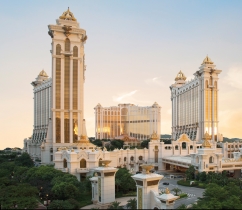
The recently opened Galaxy Macau™ represents another successful story of an integrated leisure facility marketed under a brand that features mixed Chinese and Western characteristics complemented by elements of MICEE tourism.
Galaxy Macau prides itself with the mission of developing variety tourism. In a market dominated by Western brands, we distinguish ourselves by adding avant-garde, creative elements on top of characteristic local features.
The project is rich in Asian cultural elements in terms of overall design, facilities and services, as we aim to build a premium holiday resort that caters to the needs of Asian tourists while bringing delightful surprises to travelers from the rest of the world.
Galaxy Macau, a holiday resort operated under our own brand name, develops its customer base by offering superb holiday resort facilities and caring, attentive hotel services that attract travelers from around the world. Here, brand new entertainment and leisure facilities continue to come on stream in different stages. They include an artificial beach, the world’s largest skytop wave pool, a private entertainment lounge in spectacular Chinese styles, and a 3D cinema. These attractions are designed to encourage extended stay by visitors and to alter tourists’ perception towards the gaming industry.
To achieve a genuine integration of Chinese and Western characteristics in management culture, we have brought together a management team comprising high-calibre personnel from all parts of the world. Meanwhile, we are also counting on exquisite services rendered by our front-desk personnel in order to foster lasting brand loyalty.
Our management team stood ready to start recruitment and training one year before the official opening of Galaxy Macau. We have established our own professional training centre and designed a training course based on our “World Class, Asian Heart” philosophy in hotel service to educate our staff team of close to 1,000 employees on our core brand values.
Within two weeks after its opening, Galaxy Macau had received several hundred thousand visitors, underpinning the level of market recognition gained on the back of its business philosophy and diverse range of facilities. The initial success has provided a strong foundation for our future development.
For China’s hotel industry, brand-building would be a long-term process with profound significance, requiring persistent effort, good market sensitivity and judicious management. Despite having a population of only 200 million, as compared to 1.3 billion in China, the United States is a dominant player in hotel brands. Right now, China’s hotel industry is still undergoing the early stage of development. In the future, we need to build our own hotel brands, as we have a market large enough for further growth of the hotel industry. If we seize the right opportunities, there is no reason why we Chinese businessmen would not have our own proprietary hotel brands in the future.
It is my sincere hope that the esteemed members of our academic community and hotel industry will continue to study the prospects of building Chinese hotel brands and developing them into names with international standing and fame. Thank you.