



.jpg)


Speeches and Transcripts
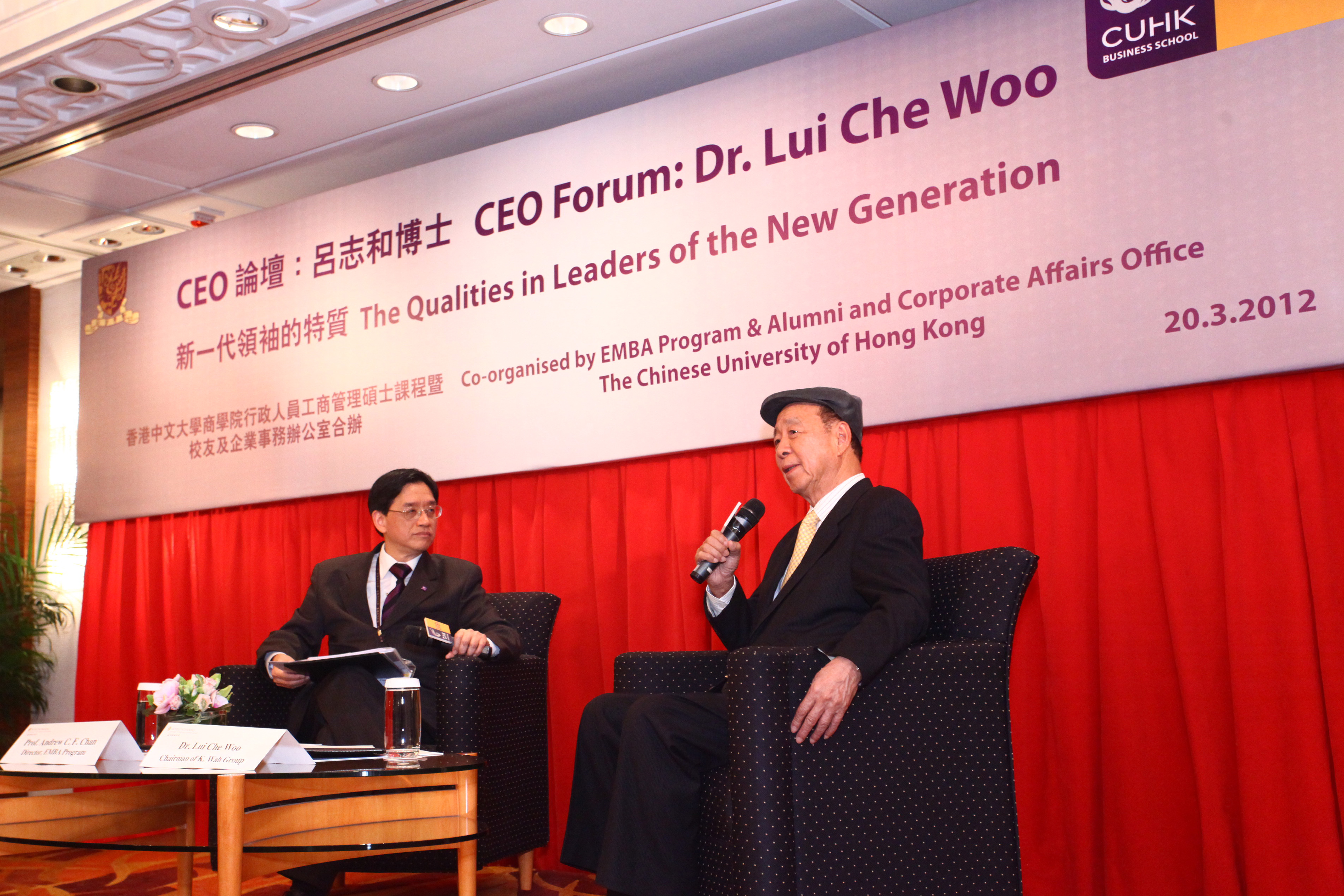
CUHK EMBA Forum
Dialogue with Dr. Che-woo Lui: Qualities of the New-Generation Leader
CUHK EMBA Forum
Dialogue with Dr. Che-woo Lui
Date: 20 March 2012
Venue: Academy Room, 1/F, InterContinental Grand Stanford Hong Kong
Topic: Qualities of the New-Generation Leader
Chan: Professor Andrew Chan Lui: Dr. Che-woo Lui
Chan: Our topic today arguably underscores a popular issue of late: what qualities should the new leader possess? However, please don’t ask any questions about the election. We are not going to respond to that. So please stay focused on today’s topic. So why are we here today chatting with Dr. Lui? It’s because Dr. Lui cares a lot about us and has expressed the wish to share with CUHK’s EMBA classes. So I called him and suggested a forum session to be held. To this he replied: “Professor Chan, if a forum is to be held, incisive questions should be asked. I don’t know how to answer questions that are otherwise. The more incisive the questions are, the more depth I can provide in response.” So why are you so keen on sharing your insights with us?
Lui: Thank you for your arrangement, Professor Chan. I don’t have any prepared scripts, so I will just have to give instantaneous response to your incisive questions. Pardon me if I fall short of a satisfactory answer.”
Chan: Of course. Now the first question: Dr. Lui frequently talks about management succession, about how work should be passed on to others. Do you have any idea how old Dr. Lui is? He is 80. Why are you still going to work? Why don’t you pass on all your duties to others and spend more time playing golf? Are you reluctant to give up work? Or do you have worries others might not be up to the task?
Lui: To build a heritage, you need to have someone passing on knowledge on one end and someone receiving it on the other. I see the true meaning of life in a person passing on his knowledge and others being able to grasp and further it.
Chan: So to what extent have you passed on your knowledge?
Lui: Do you mean to what extent have I been successful? I don’t think it could be measured this way. You do your part passing on your insights and experience, but it’s up to others how much they could grasp. You have done your task if you have expressed and communicated your thought in good will.
Chan: When did you start passing on your work and how did you plan it?
Lui: It also depends on whether the people on the receiving end will carry on the work according to your intentions, whether he has any new idea of his own, and whether the new idea blends with the old. The whole process becomes meaningful only when all these are achieved.
Chan: I see. Sounds like you had entrusted certain premeditated plans to others but it did not turned out exactly the way you had wanted. It is always a difficult thing to do. Take driving as an example, one will never learn to drive unless he actually mans a car in the road, but then if you let go of him, he might end up crashing. What’s your experience in this regard? A tycoon once told me an example in management succession: “There was this project which I knew my son couldn’t handle, which might end up with losses in the region of $20 million. I knew it wasn’t going to work, and that’s what I told him. But since he insisted, I let him do it. And a $20 million loss we did incur. However, since then my son has become more mature.” What will you do: let him drive and risk crashing? Or get him a second-hand car that he can afford to crash?
Lui: I am not sure whether it’s correct to use the phrase “management succession.” As I just said, since you have that particular experience and you are no longer in the role of an executor, then naturally you would like to pass on the task of execution to others. When implemented, it might not necessarily be what you wanted. There is a Chinese saying: “providing guidance in a positive manner and with patience” (循循善誘). We have to provide guidance in the process, which might be a short one if the person does well in following it, or a longer one if he doesn’t. We have to be patient. That’s the first step. The second step would involve implementation, but that’s not up to you. It’s up to the second generation or your intended successor.
Chan: I see. Now the second question. My impression of you had always been that of an industrialist engaged in down to earth businesses, until I read in the newspapers one day that Che-woo Lui had become China’s King of Gamblers. I am sure many have asked the same question: why the gambling industry and what prompted your decision then?
Lui: Yes, many friends have asked this question. Frankly, I don’t even know how to play those gambling games in the casino. But the reason behind my decision has to do with the idea of “management succession” and how we drive a project. Why were we granted the gaming license? How should we handle that? These were once difficult questions for me. How was I, who didn’t have the slightest idea of how to gamble, going to run a casino? In this case, I was on the receiving end of the transmission process. I had to learn what other had been doing before me and what the prevailing trends were, so that we could do it in an innovative manner with new ideas and new equipment, namely to run an entertainment and leisure business in a modern approach. We followed this conviction in what we did. Even now, I often tell my staff and my children it is imperative that we blend Chinese ways with Western methods to create an ultra-modern and innovative product. I will let the public be the judge whether we have achieved that, although I am confident to say that our entertainment and leisure facilities are now arguably the best and most lavish by world standards.
Chan: I do believe this makes a very good research topic. In a business world where only positive results matter, you run a company on the strengths of traditional Chinese culture and treat the staff team as a large family, so much so that the trade union have been shut out. K. Wah has impressed me as a rather aggressive company. At times it actively expanded its land reserve. During other periods, it established new companies, entered into new businesses and tapped the Mainland market. It is a very dynamic company. But dynamism may easily turn into impetuousness. How do you deal with a situation where your staff work hard enough but their plan may appear too aggressive. How do you draw the line? Are there any examples?
Lui: The golden rule for success is always dynamism coupled with aggressive efforts. However, being too aggressive may sometimes make you impetuous, so you also have to be meticulous. Chances are you will get much better results if you are meticulous enough.
Chan: So we have to commit full efforts with a meticulous and inquisitive attitude. But you haven’t answered my question yet: have you ever fired any employees. As much as you treat every one of them as family, is there any behavior which is intolerable to you such that you have to show him the door?
Lui: Definitely there have been cases when we have to give out termination letters, but they only account for a very small proportion. The more usual scene is staff receiving 30-year or 20-year long-term service awards.
Chan: I know you have been reading STEVE JOBS. What do you admire him for?
Lui: His book is probably too subtle for me. Nevertheless, I believe his greatest strength is his serious attitude. He always comes up with some results in anything he does. That’s why he has been able to deliver a pragmatic product that no one else could have contemplated or envisioned. Seriousness is easier said than done.
Chan: It’s not easy even to talk about it. Look at the assignments handed in by our students and we can tell whether they have been serious enough. You’ve got to be serious whether you have got the talent or not. That’s the first principle.
Lui: Talent is born, not acquired. How do we drive and plan our work? How do we identify goals and objectives? A leader should make serious pursuits in connection with these questions and seek assistance when he faces difficulties, or achieve his goal through innovative actions. I believe that Steve Jobs’s achievements all come down to these principles. But it will be a matter of chance whether others could at the end of the day also achieve what he has achieved.
Chan: You probably know that I like to sing Cantonese operas. Talent aside, you have to practice very seriously in order to sing well. Even extremely talented singers need to practice day and night for a performance.
Lui: Talking about drama and singing, I have been told that a good voice, good looks and good artistic skills are imperative for a successful artist. Even if you are very talented, you will need constant practice to ensure a perfect performance. Take golf for example, one need to hit 2,000 shots a day in order to enter the qualifying round of a golf tournament, and that of course takes a lot of serious effort. After the 2,000 shots, you still need to compete and win in the qualifying round before joining the tournament.
Chan: Do you think that wisdom and intelligence can actually be nurtured? Or are they innate?
Lui: Intelligence is in the DNA, although family upbringing could also help. The most important thing is the ability to identify and grasp opportunities. If you fail to grasp these opportunities, your intelligence is at best 50% used. If you are able to grasp it and go on to complete your work, your intelligence will be better realized. In my opinion, intelligence is inborn but it also benefits from family upbringing and depends on whether we are willing to work hard, making use of our talents and intelligence seriously to add substance to our creative or innovative efforts. This is how an opportunity comes by.
Chan: Can you illustrate what you just said about intelligence and grasping opportunities by telling us about the story of the drifters?
Lui: I got it somewhat by chance. At that time, quarrying and road construction in Hong Kong were largely conducted through manual labour. On one occasion, a friend of mine bought a small dredger at a government auction. He showed it to me and I thought it was nice, only that the use of machinery was not common at the time and it wouldn’t be of much use even if I bought one. Nevertheless, I got an impression of these machines. Later, I went to Okinawa by chance and there I learned how a drifter operated. I remembered watching Henry Fok (霍英東)’s dredger vessels in action. They sailed into the sea at tidal rise and manually removed the sand onto the vessel in baskets when the vessel was left suspended on the sand by tidal fall. I thought I could make a fortune if I bought a few dredgers for operation on the sea beds. So I did buy them and tell Henry Fok, who immediately ordered several units. Henry Fok made a good fortune in dredging, which he conducted on a government licence. His profit multiplied after he resorted to machinery and sold the sand at the same prices as before. Such were exceptional opportunities coming about at extraordinary times, but you’d got to be able to identify them. If I had not kept an impression of my friend’s dredger, it wouldn’t have occurred to me that they might be useful when I saw them in Okinawa.
Chan: Was the U.S. army withdrawing from Okinawa at the time?
Lui: Yes. Those machines were left behind by the U.S. army.
Chan: At their original prices, these instruments would not have been affordable for you.
Lui: It would have cost me 50 to 100 times more, at the original prices.
Chan: So you purchased these machines at a price equivalent to 2% of what it was worth originally.
Lui: I understand that Professor Chan wants me to talk about how I earned my first fortune. Well, in fact there was no secret. My views on these machines were formed in the larger context of the development of civil engineering work in Hong Kong. At that time, I went to watch the [stone pitching] (渠邊石) operation of a person to whom I had extended a loan. I noticed that they used traditional and backward methods to dig up stones. The lesson I have learned is that we have to understand the work process of an industry which appears to hold out potential, so that when the opportunity does come by, you will be equipped with the mechanical and technical knowledge required for your business development. If you don’t have some knowledge of the business, you won’t be able to do anything and the opportunity will be wasted. This sounds like basic terms in life, but in practice it requires understanding, common sense and intelligence. While I was presented with this good opportunity in Okinawa, I had to figure out how to ship these machines back to Hong Kong, otherwise I wouldn’t be able to turn the opportunity into real profit. The U.S. army exercised stringent control over the export of the wartime supplies they left behind. People who sought to ship the machines out for purposes other than self-use were required to seek third-party guarantors who pledged to buy those machines. This was where good connections came in, in addition to intelligence and knowledge. I needed friends who were willing to act as my guarantors, who would be asked to explain to the U.S. Consulate why they were prepared to buy the machines from me. At the time, I asked Mr. Chen Ping-kwan (陳炳坤) of Wah Luen Construction Company (華聯建築公司) and Fok For-kan (霍伙根) of Yau Wing Company (有榮) to act as my guarantors, and the machines were eventually shipped to Hong Kong. As a businessman, you have to build your credentials so that other people are willing to help based on their understanding of you. Connections cannot be established overnight, and the time spent will translate into factors that contribute to your future success. Otherwise, it may take a long time to secure guarantees, and the opportunity might be lost.
Chan: To sum up, it is always good to have more friends and, secondly, we should look beyond the immediate future, for it always takes time to build understanding and gain success in any venture. What do you think is your most outstanding strength?
Lui: I don’t see any particular strength in myself. Perhaps the fact that I am still not retiring is worth some admiration.
Chan: We can draw one conclusion from what we have been discussing: all successful companies excel on the back of their philosophy, not rules and regulations or efforts to boost financials. The way you have treated your employees as family is in fact a manifestation of traditional Chinese wisdom. While China is today garnering international respect as it becomes the second largest national economy of the world, its soft strengths have yet to be “passed on” to become a significant ideological force in the world, so that more people would come to appreciate that, other than Communist ideology, China does have a subtle cultural heritage represented by philosophies of the likes of Laozi, Confucius, Mencius and the Legalists that have stood the test of history for over 4,000 years. Do you find traditional Chinese thoughts useful for corporate management? Do you apply ideologies such as the philosophy of Laozi, the Confucian notions of civility, righteousness, integrity and shame-consciousness (禮義廉恥) and the Buddhist notion of mercifulness?
Lui: I am a great admirer of traditional Chinese culture, because Confucianism is focused on people and how they live with one another. In other words, it’s about team spirit and cooperation with your fellow people. The shortcoming, though, is that it seems to be over-emphasizing the importance of human compassion. The Western approach to management, on the contrary, is devoid of the human element. There is this polarized situation where employees want nothing but a raise while the employer gets to fire anyone who does not meet his standards. We should try to blend Chinese and Western characteristics to avoid these extremes. In the United States, where Chinese culture is not very influential, measures that blend Chinese and Western thoughts are quite helpful. At Galaxy Entertainment in Macau, we also adopt a blended approach that follows the Las Vegas model in operational management and accounting and the Confucian approach in personnel management. Employees are treated like family and the results have been rewarding. Dear professors and students, we should find ways blend Chinese culture with foreign management concepts and approaches and I believe China will eventually come out on top of other nations if we manage to do so.
Student Lee: I hope that CUHK could consider ways to increase our influence. 90% of the Americans have no idea about this aspect of Chinese ideology. Under the influence of local media, they have closely identified China with the Chinese Communist Party, which is not something that I want to see.
Student Wong: I would like to ask Dr. Lui a question about values. How do you measure the success of the new-generation leaders? To many people, Dr. Lui is a very successful person. Do you see yourself successful?
Lui: Am I successful? I am still in the process of learning. We are living in such a big world so we simply couldn’t say for sure that we have already succeeded. But I do try my best to do a little bit more, to excel above the rest. I would like to see perfection in the products I made, and would love to garner public recognition from users like you. But we should never be complacent, knowing that there will always be someone who comes out better. Let me tell you another story: when I started my business, it cost up to $3,000 in black market price to have a telephone installed in my office. Now it costs less than $300. This underpins the progress of the world, the ever-changing development of our society. We need to keep pace with it and offer something creative that meets the requirements of the world.
Student Cheung: Thank you for sharing with us. May I ask who’s you hero among leaders in Asian countries or China? Are there any Western leaders whom you admire?
Lui: Human civilization has a history of around 3,000 years and many great people have lived. I am saying this to you in all sincerity and, in fact, I have only started to say this recently: Many people have died and suffered because of the wars and predicaments associated with Mao Zedong, so people have different views about him. From the broader perspective of Chinese history, however, it was a time of warlord hegemony and endless warfare. Even overseas Chinese were asked to send money back to China to finance the wars. Looking back, while the revolution has cost the lives of 20 to 30 million people, China did start to rise as a world power in about a decade. On this basis, it’s fair to say that Mao was a great personality. I wish to stress that this is entirely my personal point of view. After all, the progress of the world does not count on just one single person. Rather, it’s the combined result of the contributions and innovations of many. As the Chinese saying goes: “a victorious battle is won over the dead bodies of many.” There is a price to pay for every success. The most important thing is that we act according to our conscience.
Chan: Are there any foreign leaders whom you admire? Such as leaders of the United States or France?
Lui: I am not well-learned enough to comment on that, as I am more familiar with modern Chinese history before and after the civil war. I believe there must have been numerous heroes in other countries that have made significant contributions, such as [Washington who united the South and the North of the United States without resorting to violence]. About 20 to 30 million people died in the course of China’s revolution, but we should let history judge whether this cost is justified.
Student: You have just mentioned building staff teams with the help of Chinese culture. Given the size of your company, how have you managed to influence your management team and have them influence the staff in general, so that everyone follows this somewhat personal approach? What’s the secret?
Lui: As far as management is concerned, the size of the company doesn’t really make a difference. Large company or small, you always lead by example. A hardworking employer is not likely to have lazy employees. Of course, things don’t always turn out in exactly the way you have wanted. You need to provide leadership in order to complete a project and be accommodative when your people aren’t exactly performing up to your expectations. These are the prerequisite qualities of a business leader. Take our project in Macau for example, I have been playing a leading role all along, otherwise we would not have achieved such results. You’ve got take the lead, although you should also give opportunities to others and train them, so that they will become ready helpers. When they do, it means that there will be several people contributing at the same level as you. It all sounds simple but requires a lot of painstaking efforts in practice.
Staff: I am a management trainee who joined K. Wah Construction Materials recently. Our theme today is about the qualities of a leader in the new generation. Dr. Lui, you are doubtlessly an experienced businessman. Which qualities do you think were important in the past and are still important now, as Hong Kong continues to evolve change? Which ones are especially important for the younger generation?
Lui: We are talking about leadership here today. The answer to your question may vary, depending on what industry we are in. The qualities required of an army general are different from those required of a statesman. When people work in different positions, they are bound to employ different means to fulfill their tasks, but generally a leader should always be innovative and lead by example. Take Mao Zedong for example, he was an army commander, and he provided a lot of wise counsel and leadership. These are the basic qualities for a leader. I don’t see how a person without these qualities or a person that isn’t motivated or meticulous could succeed.
Chan: Is there any difference between the qualities of past business leaders and their modern counterparts?
Lui: Fundamentally, no. It mainly depends on what business you are in and how you apply those principles. A business owner can never afford to be lazy. I just read today the news of the fight within the family owning SAMSUNG. I remember visiting SAMSUNG 20 to 30 years ago. The boss told me that his father, who was the founder of the company, was out of town and asked me to wait a few days for him. This was more than 20 years ago, when their founder was already in the habit of going the United States in person to study the development of electronics. Subsequently, SAMSUNG’s CEO thrice ran into trouble. On one occasion, he decided to destroy thousands of product units and had them manufactured again. That’s what the SAMSUNG products we have today have come through. He showed strong determination by starting everything anew when he was sure that the products made might not suit the market. It was this serious determination that has made SAMSUNG the largest manufacturer in South Korea. With necessary adaptations, this is the kind of principle that will ensure success in business of any scale, large or small.
J. Y. Sung: There are two types of leaders: the employer who writes the pay checks and usually hear from employees what he wants to hear; the other type is a leader who gets paid to be criticized on a daily basis, such as me, and whose thoughts and words are not necessarily resonated with. In respect of these two types of leaders, how can the former tell truth from flattery, and how can the latter persist to stand by what is right in the face of opposition? Well I am not enrolled for EMBA; I am learning how to be a University President.
Lui: I truly feel that whatever we do, we have to stand by our own objectives and principles resolutely. If others disagree, you should try to explain patiently without causing resentment. If there is some truth in other people’s advice, you may make some adjustments accordingly, but you should never abandon your own objectives. Taking a U-turn halfway through the process will change all your original intentions. It’s fine if you succeed, but what happens if you fail? To cite again the case of SAMSUNG destroying its products 10 years ago, the owner came up with a new idea when he ultimately believed that he had been wrong. That’s how he entertained the advice of other people: he made the decision to change at the very end, not when the project just started. Maybe some see it as stubbornness, but you’ve got to believe in yourself. You must also be open to other people’s advice, but then that doesn’t mean you should change your mind easily. Rather, you should persist in achieving your goal. If unfortunately you fail in the end, you’ll have to destroy them all and do it again like SAMSUNG.
Chan: As former Premier Zhu Rongji once remarked, his continuation in work or retirement was not up to him to decide.
Student: Dr. Lui, I have read about your credentials and the history of your business career, and noted that you have switched from one position or industry to another. This is inconsistent with the practice of a traditional Chinese businessman, who tends to do only what he is familiar with. On more than one occasion, you disposed of your entire existing business and pledged the whole stake on a new business. What were your calculations behind those moves? What made you believe you would win? From a seller of Chinese pastries, auto parts and then drifters to a casino magnate, your business has burgeoned enormously. This boldness in staking the entire fortune is certainly exceptional. As a well-known tycoon, how do you judge whether a person has the quality to create wealth.
Lui: I did ask myself that question, too. Why did I change my path when I seemed to be doing well without any issues? The point is, as I said earlier, there are always things, good or bad, to sidetrack you. When an opportunity does arise, I will first consider whether it is something I am capable of doing before looking into its details. Next I will ask myself whether I’ve got the relevant skill sets, plans and resilience to put it into action. If you are capable of doing it and you have a pretty good understanding of the industry, then you should try it by all means. In fact I have not refocused my business many times for the past 60 years. The gaming industry in Macau, for example, is not what I originally wished for. I just hoped to develop a business that I am experienced in (the hotel industry) in a place that I was familiar with. The rest of the story is history. We started to solicit help from industry veterans elsewhere. At first the Americans were not interested in us, thinking we Chinese wouldn’t be able to do it. So I went to Australia and recruited their experts. Later when our business grew, the second ranking gaming operator in Las Vegas offered to help us. Therefore, even if your business is growing, you still have to be aware of what’s happening around you. Many people would say that investing and establishing a business is difficult. It is true to a certain measure, but we have also seen small shops making big money and multiplying into chain operations. The opportunities are always there for us to grasp. We should try taking it and developing the business step by step. For example, My family and I used to be involved in two to three business segments - expanded first to the United States and then to Macau. In the property sector, I am not known to be an aggressive player. If you try to check it out, you will find that the eight buildings of the Cha Kwo Ling project built in the 1950s are still there. Later, I shifted my focus to construction materials. There was a period when the property market plummeted and many property developers went bankrupt. It was during this period that Dai Cheong (大昌), Cheung Kee (章記) and Kar Nin (嘉年), once industry leaders, bowed out of the market. Therefore, as much as we are determined, we also have to be prudent and conservative, preserving our strengths for the right moment.
Student Chan: I was involved in the construction business in Macau during 2003 to 2008, including the construction of the hotel of your group. The gaming industry of Macau has not been rosy in the past few years. Since you have been running your own business for 60 years, you must have seen times of changes, as well as times when there is a lack of changes. One of the subjects taught in CUHK’s EMBA is I Ching or The Book of Change (易經). In your opinion, what can I Ching offer to the new-generation leaders or your successors?
Lui: This is a difficult one. All I know is that I Ching is an extremely subtle work in Chinese culture, which I haven’t had the privilege to read, though I believe it must contain very valuable insights. I suspect there are few people who genuinely understand I Ching and its implications for the world. Maybe it’s extraterrestrial.
Chan: I Ching is our signature course. [The professor has learned it through self study.] It’s about approaching an issue from different modes of thinking. There are 8 approaches under different circumstances. May I say it is a form of inquisition, rather than superstition.