
.jpg)


Speeches and Transcripts
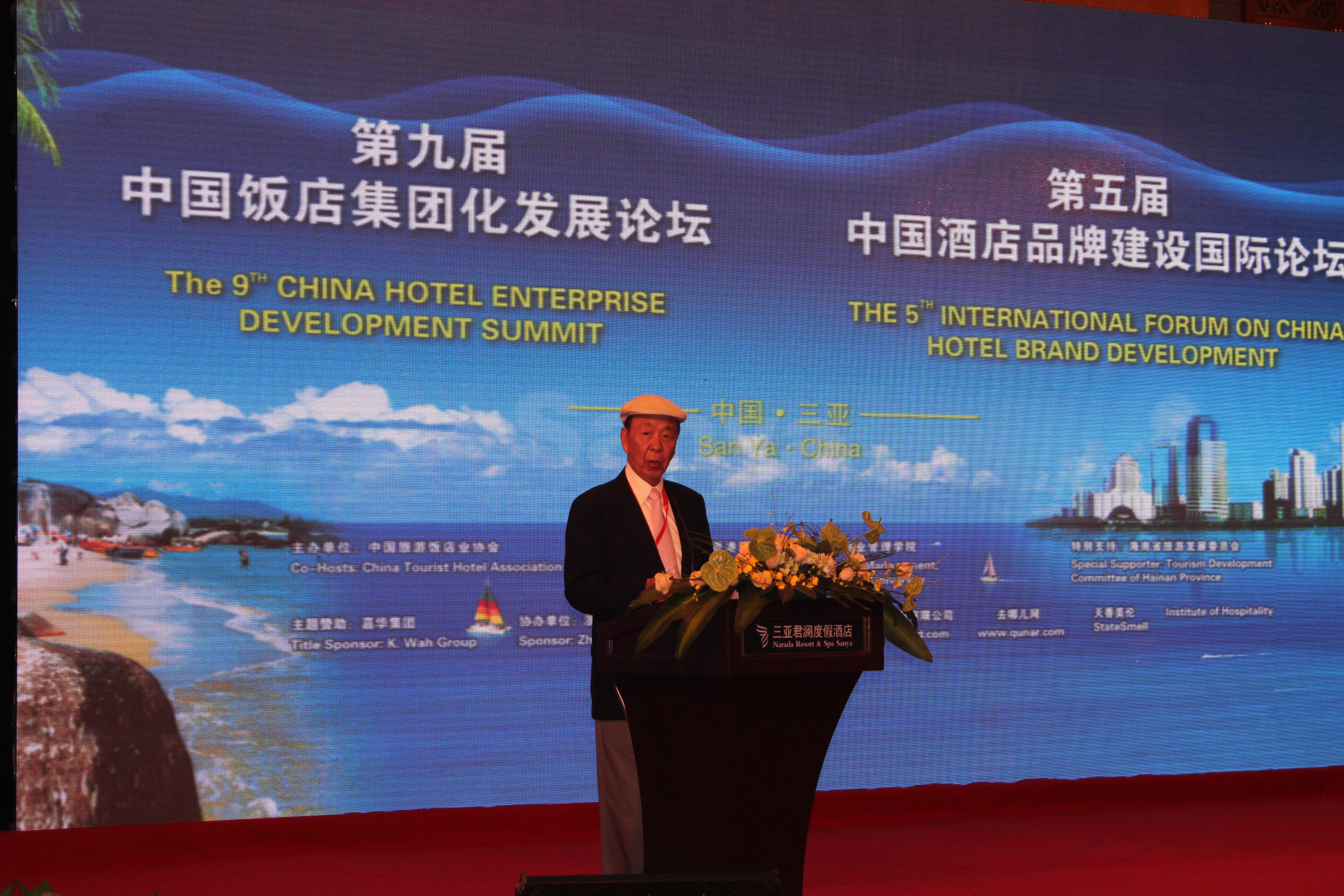
The 5th International Forum on China Hotel Brand Development
The 5th International Forum on China Hotel Brand Development
20 June 2012
Grand Ball Room, Narada Resort & Spa Sanya, Sanya
Mr. Wu Wenxue, Mr. Wu Kunxiong, Mr. Zhang Rungang, Dean Kaye Chon, dear guests and friends,
Good morning. First of all, I must thank The Hong Kong Polytechnic University (“PolyU”) and China Tourist Hotel Association for their wonderful arrangements in inviting this great company of fellow hotel operators to attend this forum. It is especially meaningful to discuss the path of hotel brand-building in Hainan, a beautiful island that boasts the exciting tourism sector supported by a wide array of magnificent hotels.
Increasing brand awareness
This Forum is now in its 5th edition. There was an exponential increase in the number of Chinese tourists in recent years, with an enormous demand for domestic tours stimulated by ongoing economic growth. Alongside tourism, the hotel sector has also enjoyed thriving growth. The number of hotels operated by domestic brands has grown rapidly since recent years, with some domestic hotel groups taking over the management of hotels which were previously managed by international hotel brands, such as this very hotel, Narada Resort & Spa Sanya, that we are staying at right now.
In short, we are witnessing the rise of Chinese hotel brands and an increasing brand awareness. I am sure everyone present here would like to see this trend sustained for the healthy development of the industry.
Massive prospects for the development of Chinese hotel brands
PolyU, one of the co-hosts of today’s forum, has been undertaking the mission of training professionals for the industry. As a comprehensive and forward-looking course with an equal emphasis on theory and practice, the hotel management programme of PolyU has trained up high-calibre management professionals for the sector over the years, while hosting seminars and forums from time to time to investigate the management approaches of related industries and invite in-service professionals to share their experience, so that academic research can be complemented by the study of practical cases. The present forum, held each year in a different Chinese city to advocate brand-building, has provided a platform for discussion through different perspectives.
I am glad to see that the rising international standing of PolyU School of Hotel and Tourism Management, ranking 2nd at present among the world’s tertiary hotel management programmes. The completion of its teaching hotel last year has marked yet another new milestone in PolyU’s endeavour to train hotel professionals.
Advanced brand management programmes
After nearly 40 years in the hotel industry, I have developed a profound appreciation for branding. I have also exchanged views with the experts and academics of PolyU from time to time to discuss how the programme might be further enriched with innovative ideas in keeping with social and technological progress. During a discussion taking place a few years back, we all felt there would be enormous prospects for the development of domestic hotel brands in China, which would represent massive opportunities for economic development.
Take the United States for example. With a population of approximately 200 million, it has nurtured a host of world-famous hotel brands, underpinned by a sophisticated model of franchised operations by hotel groups. China, on the other hand, has a population of 1.3 billion and the size of her economy is large enough for domestic hotel brands to develop and expand. As the future development of China’s hotel industry is likely to be focused on branded hotel chains, we can learn from the more sophisticated and systematic model of franchised hotel brand management adopted in Western countries. In this regard, university education in professional management should have an important role to play.
With increasing commitment of national resources to the tourism industry and stronger brand awareness than before, the University should develop more advanced management programmes with broader perspectives in keeping with the progress of the society. Unlike hotel management which is mainly concerned with accommodation, dining, tourist services, air flight and other transportation, etc, brand management has more to do with all-rounded strategic thinking, brand positioning, marketing and image promotion. Hence, we must train up more high-calibre professionals who work with astute market senses and hands-on knowledge of national and market developments, in order to embrace the growth in hotel brands in the future.
Institutionalised and network-based brand management
Since the 1970s, I have invested in and operated dozens of hotel projects. I introduced the brand new concept, “franchise hotels”, to Hong Kong during the early years. We needed to rely on proven hotel management expertise available from Western countries at the time, as the people of Hong Kong were inexperienced in top-quality hotel management. Subsequently, K. Wah Group’s hotel business was expanded to major cities in the world, on the back of this management model integrating Chinese and Western elements.
Today, K.Wah owns and manages hotels worldwide. Some of them are being operated under foreign hotel brands, while over the years we have also groomed our own hotel management professionals and developed our own hotel brands, such as Galaxy, StarWorld and Stanford. While these brands have earned considerable reputation and developed solid customer bases, they have yet to fully reach the standards required of international brands.
The successful creation of a brand name is only the first step. It takes an institutionalised and network-based management system to ensure the sustainability of the brand, and the development of such system cannot be achieved without dedicated, long-term planning executed by a visionary management team with strong passion for the industry, committed leadership and shared beliefs.
Personnel training vital to brand-building
The brand name of a hotel is an important intangible asset that distinguishes the hotel from its peers and appeals to customers who identify with the unique value it creates. The demand of travelers nowadays has become increasingly sophisticated. There’s more to providing and repeating routine products and services in the function of a hotel: it must strive to bring an exceptional and unforgettable experience of hospitality to its patrons.
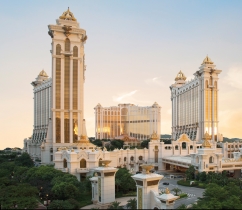
For example, Galaxy Entertainment Group under K. Wah Group has adopted the “Asian Heart” service philosophy in its entertainment business in Macau developed in recent years. This is complemented by a wide range of brand new MICEE (i.e. Meetings, Incentives, Conventions, Exhibitions and Entertainment) facilities, such as the world’s largest skytop wave pool, an artificial beach, a 3D cinema, a performance venue and a club lounge, built to satisfy different needs of our customers. The integrated facility has proved to be very popular with international tourists and has become a new landmark for entertainment and holiday resort in Macau.
Hotel brand-building is very much dependent on the training of talents. Hardware and systems can be easily replicated, but talents need to be groomed with care in order to grow into a positive force underpinning the hotel brand. We can only win customers’ confidence and loyalty by maintaining a high standard of service over a long period of time. A hotel with a successful brand is better positioned to retain high-calibre employees and attract new talents. Experienced staff with firm commitment represent the most valuable assets for a hotel, for they can motivate, inspire and educate others such that the hotel is run with maximum efficiency in a sustainable manner.
China is ready to develop its own super hotel brands
Tourism provides a direct stimulant to the retail sector in general. In its 12th Five-Year Plan, the Central Government has called for stronger efforts in the development of tourism, such as the building of infrastructure facilities and other resources and the design of a variety of tourism products with special features, with a view to creating market opportunities with lucrative potentials.
With its history and culture dating back to ancient times, China is a tourist destination with a lot of natural attractions, such as historic monuments with rich cultural heritage and breathtaking landscapes. Sight-seeing attractions and the increasing number of business conventions and exhibitions being held here are driving the growth of visitor arrivals in China. Moreover, as the nation’s economic growth is focused on the expansion of domestic demand, we must develop our premium Chinese hotel brands, as I am convinced that only Chinese know best what their fellow Chinese tourists need.
Brand-building is a long-term mission with profound significance. We are counting on top-level industry experts such as you to research further on plans and actions in tandem with government policies and principles, and I have every confidence that hotel brands developed by Chinese will establish their presence in the international market in the foreseeable future.
Thank you.